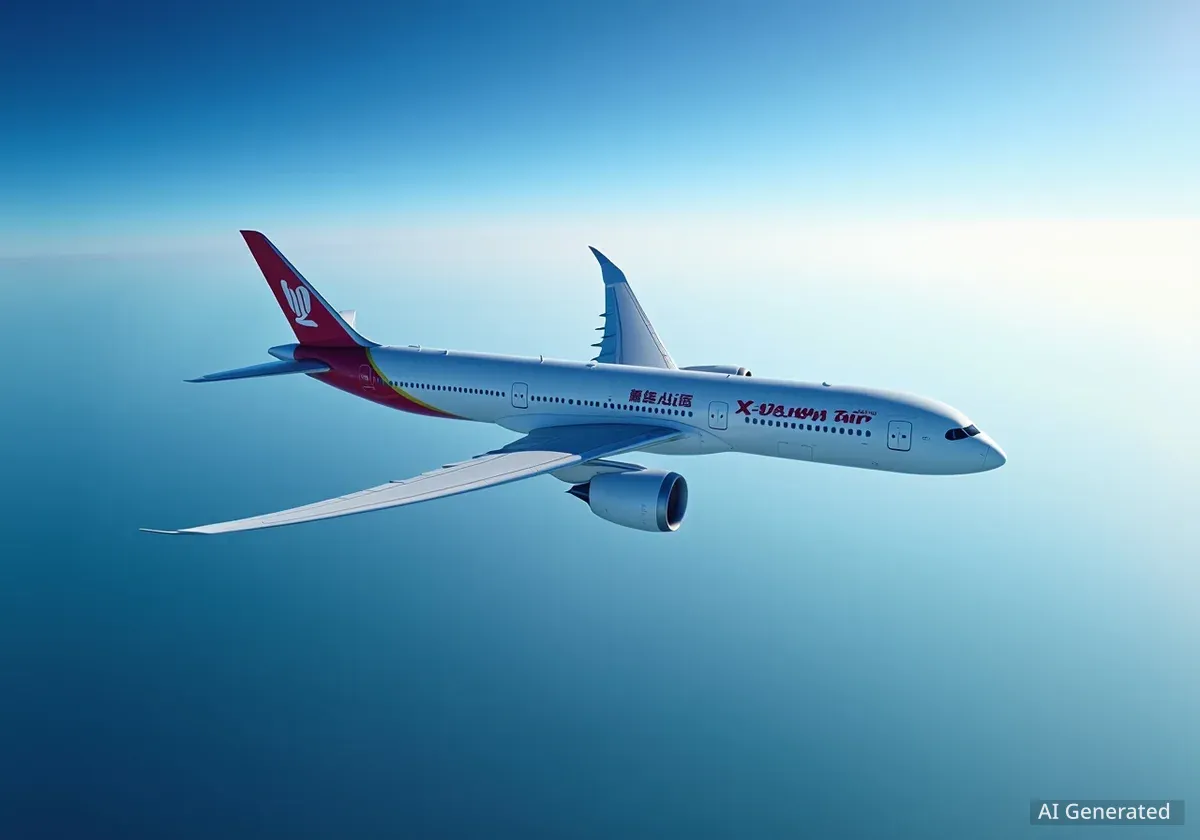
Xiamen Air has secured the title for the world's longest scheduled nonstop commercial flight with its service from New York's John F. Kennedy International Airport (JFK) to Fuzhou Changle International Airport (FOC) in China. The flight is now scheduled with a block time of 19 hours and 20 minutes, primarily due to route adjustments to avoid Russian airspace.
This new record surpasses the previous holder, Singapore Airlines' route from Newark to Singapore, by just 10 minutes. The change highlights how geopolitical events are directly impacting global aviation logistics and extending travel times on ultra-long-haul routes.
Key Takeaways
- Xiamen Air's JFK to Fuzhou flight is now scheduled as the world's longest nonstop service at 19 hours and 20 minutes.
- The extended duration is a result of rerouting to avoid Russian airspace, adding 635 miles to the journey.
- The record is based on scheduled "block time," which includes taxiing and potential delays, not just time in the air.
- Qantas aims to claim the record by 2027 with its "Project Sunrise" flights from New York to Sydney.
A New Record in Ultra-Long-Haul Aviation
The twice-weekly service operated by Xiamen Air between New York and Fuzhou has claimed the top spot in ultra-long-haul travel. While the route itself is not new, having been introduced in 2017 and relaunched in 2024 after a pause, its scheduled duration has been significantly increased.
The flight now officially overtakes the long-standing record holder, a Singapore Airlines service connecting Newark Liberty International Airport with Singapore Changi Airport. The 10-minute difference in scheduled time is enough to shift the title to the Chinese carrier.
Understanding Block Time
Aviation records for flight duration are typically based on scheduled block time. This is the total time from when the aircraft pushes back from the gate at the departure airport to when it arrives at the gate at its destination. It includes taxiing, takeoff, cruising, landing, and a buffer for potential delays. Actual time spent in the air is often shorter.
For instance, while Xiamen Air's flight is scheduled for 19 hours and 20 minutes, the actual flight time has often been closer to 17 hours. The extended block time provides a cushion for unforeseen circumstances, ensuring a higher on-time arrival rate.
Geopolitical Factors Reshaping Global Air Routes
The primary reason for the extended duration of the JFK-to-Fuzhou flight is the avoidance of Russian airspace. Since the 2022 invasion of Ukraine, many international airlines have altered their flight paths to bypass Russia, a vast territory that lies on the most direct great circle routes between North America and Asia.
According to aviation analysis from Simple Flying, this rerouting adds approximately 635 miles to the Xiamen Air flight. The total journey now covers around 8,400 miles. A more direct polar route crossing over the Arctic and near Russia would be significantly shorter, but it is not currently utilized by the airline for this service.
"The 8,400-mile route would be 635 miles shorter if the Chinese carrier used a more direct great circle route. However, you wouldn't want to chance sending a plane over the Arctic from the United States towards Russia."
This situation is not unique to Xiamen Air. Multiple carriers flying between continents have had to adopt longer, less efficient routes, leading to increased fuel consumption, higher operational costs, and longer travel times for passengers.
The Race for the Next Longest Flight
Xiamen Air's new record may be temporary. Australian flag carrier Qantas is actively working on a plan to launch even longer nonstop flights under its ambitious "Project Sunrise" initiative. The project aims to connect Australia's East Coast cities, like Sydney and Melbourne, directly with major global hubs such as New York and London.
Qantas's Ambitious Test Flight
In 2019, Qantas successfully completed a test flight from New York to Sydney using a Boeing 787-9 Dreamliner. The flight lasted 19 hours and 30 minutes, demonstrating the technical feasibility of such a route and providing valuable data on crew and passenger well-being.
Technological and Supply Chain Hurdles
The official launch of Project Sunrise depends on the delivery of specialized aircraft. Qantas placed an order in 2019 for 12 Airbus A350-1000ULR (Ultra Long Range) aircraft, which are specifically designed for these marathon routes. These planes will feature a reduced passenger capacity and enhanced cabin amenities to improve comfort on flights lasting nearly a full day.
However, developmental and supply chain delays at Airbus have pushed back the delivery schedule. According to reports from Skift, the first of these specialized aircraft is not expected to arrive until late 2026. As a result, Qantas now aims to launch its New York to Sydney service in 2027.
What This Means for Travelers
The push for ultra-long-haul flights offers travelers the convenience of avoiding layovers, which can save significant time and reduce the hassle of connections. For business travelers, in particular, a nonstop flight can mean arriving more rested and ready for meetings.
However, spending over 19 hours in an aircraft presents challenges. Airlines are focusing on passenger wellness with features such as:
- Specialized cabin lighting to reduce jet lag.
- Menus designed to promote hydration and sleep.
- Dedicated wellness zones for stretching and movement.
- Reduced cabin density for a more spacious feel.
As airlines continue to push the boundaries of aviation, the competition for the "world's longest flight" title will likely intensify. Geopolitical stability, fuel prices, and aircraft technology will all play crucial roles in determining the future of ultra-long-haul travel.