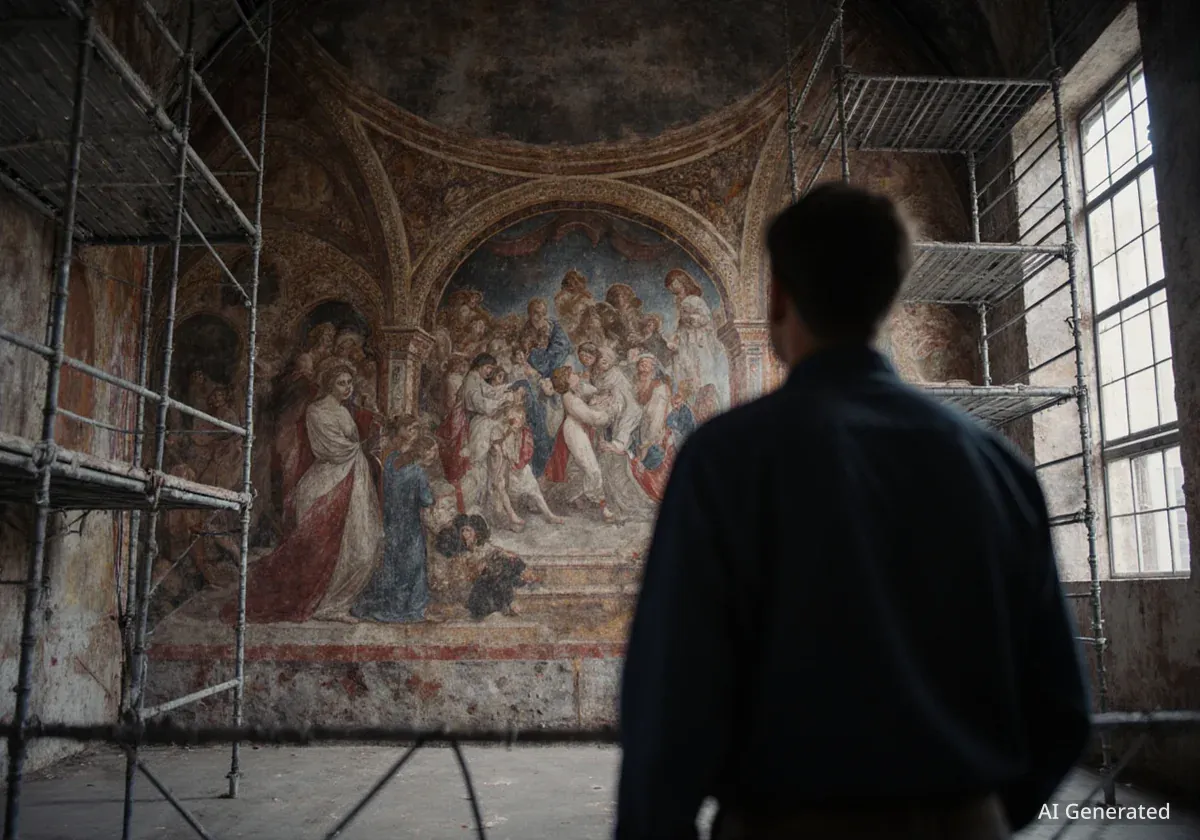

In downtown Luanda, the once-prestigious Globo Hotel now stands in a state of disrepair, with broken windows and cracked walls. Decades after its last guest checked out, the building has found an unexpected new purpose. It has become a vital center for the city's contemporary art scene, housing studios, galleries, and performance spaces for a new generation of Angolan artists.
Key Takeaways
- The derelict Globo Hotel in Luanda has been repurposed by local artists into a creative hub.
- It now contains numerous artist studios and galleries, fostering a new wave of Angolan contemporary art.
- The initiative is part of a broader cultural movement in Luanda, with new art spaces emerging across the city.
- Artists at the Globo focus on themes of female empowerment, precolonial history, and social change.
From Modernist Icon to Creative Sanctuary
Fifty years ago, the Globo Hotel was a symbol of modernity in Luanda. Its clean lines stood in contrast to the city's Portuguese colonial architecture, making it a fashionable destination. However, as Angola's oil-driven economy boomed, luxury accommodations shifted to modern glass towers along the waterfront, and the Globo was left behind.
The building fell into disuse, its sign and awnings collapsing over time. For years, it was just another abandoned structure in a rapidly changing city. Its transformation began about a decade ago when a group of artists quietly organized an underground event within its walls, an act of creative reclamation in a country still emerging from decades of civil war.
The event was a success, leading to more gatherings and eventually a documentary film. Some artists decided to stay, converting the old hotel rooms and service areas into permanent workspaces. This grassroots movement turned the forgotten hotel into what many now consider the epicenter of Luanda's artistic revival.
A City in Transition
Luanda is the capital of Angola, a nation that experienced a 27-year civil war that ended in 2002. The post-war era has been marked by rapid economic growth, primarily fueled by oil exports, making Luanda one of the most expensive cities in Africa. This period of change has created a dynamic environment for cultural expression and urban redevelopment.
Spaces for Creation and Community
Inside the Globo, nearly every corner has been repurposed. The former laundry room is now home to Studio Ndako2.4.4, founded by artists Irene A’mosi and Débora Sandjai Leonor. The name Ndako means "house" in Kikongo, one of Angola's national languages. They have created a space specifically focused on supporting female artists.
"Débora and I developed a space where women find a way to develop a program that can help us work," A’mosi explained. "In the previous generation, more men than women were making art. Women had to make a lot of sacrifices along the way if they wanted to practice art."
The studio is filled with books, paints, and canvases. It also features a collection of rodilhas, colorful circles of cloth traditionally used by women in Luanda to cushion heavy loads carried on their heads. This detail reflects the studio's mission to center female experiences.
Another resident artist, Wyssolela Moreira, uses her studio at the Globo to explore Angola's precolonial history and spiritual traditions. Her work often incorporates natural pigments used in healing ceremonies and rituals.
Connecting with History
Moreira's art delves into Angola's past, a history stretching back over five centuries to the arrival of the Portuguese. She researches written archives and reconnects with historical locations to find symbols for her work. Some of her pieces recreate traditional ritual scarring on paper and fabric.
"I use natural pigments that are present in my spiritual practice. They’re used for healing ceremonies, rituals of passage," Moreira stated. She describes her process as intuitive, guided by a connection to ancestral spirits and practices.
For artists like Moreira, the Globo provides more than just a physical space. It offers immersion in a vital artistic community. "For there to be a place like Globo that welcomes artists with different practices and allows us to occupy space to create art and contribute to the contemporary art scene of the city is super important," she said.
A Hub for Emerging Talent
Ngoi Salucombo, who coordinates cultural programming for the Goethe Institut in Luanda, calls the Globo a critical location. "If you want to find the new generation of artists — not all the people, of course, but some of the important people inside of the circle of the art — I think Globo is the place," he noted.
An Art Scene Spreading Across Luanda
The energy emanating from the Globo Hotel is part of a larger cultural expansion in Luanda. The hotel has acted as an incubator, with its artists and collaborators launching projects throughout the city. Mehak Vieira, founder of JAHMEK Contemporary Art, maintains a gallery at the Globo but also curates spaces elsewhere, like the Sky One Gallery in a modern office tower.
Vieira's work aims to build infrastructure for Angolan artists, helping them gain international recognition at prestigious events like Art Basel. "It’s this moment that we’re actually creating the spaces for these artists to occupy," she said.
Art as a Social Tool
The movement extends beyond the city center and into sprawling neighborhoods like Cazenga. There, a community program called Anim’art provides afterschool arts education, filling a gap left by most public schools. Vieira collaborates with Anim’art, bringing professional artists like Wyssolela Moreira to exhibit their work in its community centers.
This initiative bridges social divides. Moreira considers her exhibit at Anim'art one of her most significant. "Classism is a big issue here," she said. "As contemporary artists, we understand art to be a tool for social reformation, social change. So, it’s important to be part of projects that will take the art to the hood."
Building a Sustainable Arts Market
As Luanda's art scene grows, so do efforts to create a more formal market. Dominick A Maia Tanner is a key figure in this professionalization. He established the Africell Luanda Feira de Arte (Luanda Art Fair) and a monthly event called Noite das Artes (Night of the Arts), which features late gallery openings and free transportation between venues.
These initiatives aim to connect new artists with a broader audience, moving beyond informal sales to expats. "Economically, they generate a ripple effect — benefiting local businesses and reinforcing the arts as a driver of urban development," Tanner said. He believes these events help integrate art into the "fabric of everyday life."
Other hidden galleries are also appearing. Alexandra Goncalves, a former lawyer, opened The Art Affair gallery in an upper-floor apartment of a mid-century building. She represents photographers like Paula Agostinho, showcasing a diverse range of local talent.
From the repurposed rooms of the Globo Hotel to community centers in outer neighborhoods and galleries hidden in plain sight, Luanda's artists are reshaping their city. They are not just creating art; they are preserving heritage, challenging social norms, and building a new cultural identity for Angola, one building at a time.