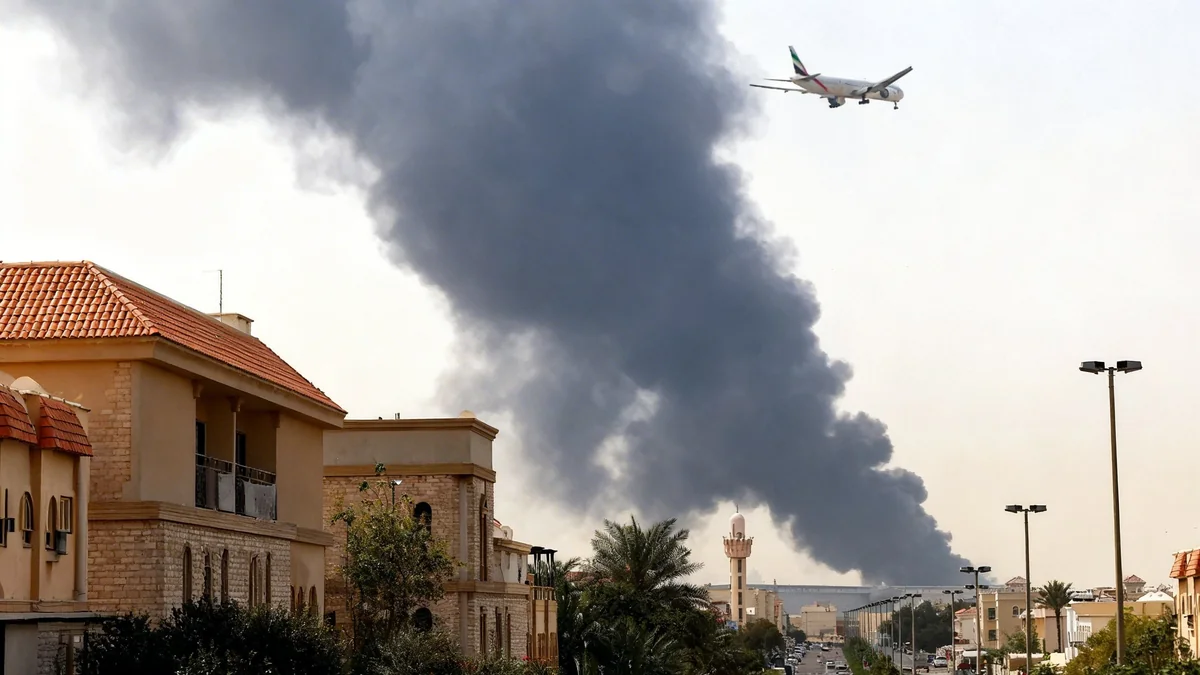

One year after a deadly midair collision above Washington, D.C., significant safety improvements at Ronald Reagan National Airport remain incomplete. While the Federal Aviation Administration (FAA) has implemented some changes, including reduced flight numbers and redesigned air routes, critical issues like air traffic controller staffing and morale continue to raise alarms among aviation experts and victims' families.
Key Takeaways
- Air traffic controller staffing at Reagan National Airport remains below approved levels.
- Morale among controllers is low, raising concerns about operational readiness.
- A critical cockpit broadcasting system for military training flights was mandated, then unwound.
- Families of crash victims express frustration over slow and reactive safety measures.
- Congestion in the airspace around the airport continues to be a major concern for lawmakers.
Lingering Staffing and Morale Issues
The control tower at Reagan National Airport, which managed the flights involved in the 2025 collision, still faces challenges. Staffing levels have seen only a slight increase since the incident. The FAA reports 22 controllers are currently employed, an improvement from 19 at the time of the crash. However, this figure remains below the approved 30 controllers for the facility.
Beyond the numbers, individuals who have recently spent time in the tower indicate that morale among controllers remains low. This situation raises questions about the long-term readiness and well-being of the team managing one of the nation's busiest airspaces.
By the Numbers
The Reagan National Airport tower is approved for 30 air traffic controllers. At the time of the fatal collision, it had 19 controllers. Currently, it employs 22 controllers, along with 8 trainees.
Following the crash, some controllers took immediate leave. Senior managers were also relocated. The top position, air traffic manager, has seen three different occupants in the past year, with other management roles sometimes left vacant. James Jarvis, a former FAA contractor who worked in the tower for years, noted that the agency has not always prioritized the facility, despite its importance.
“The F.A.A. and the public consider D.C.A. a gem,” said Mr. Jarvis. “We have not treated it like a gem.”
The psychological toll on controllers in the aftermath of the crash was significant. Jennifer Homendy, the National Transportation Safety Board (NTSB) chair, observed many controllers were highly distressed during interviews, with some crying. One incident involved an altercation between two controllers, leading to an arrest. This prompted the NTSB to express serious concerns about controller well-being to FAA leadership.
The Collision and Government Response
The fatal collision occurred on January 29, 2025. An Army Black Hawk helicopter flew into American Airlines Flight 5342, which was on approach to Reagan National Airport. All individuals aboard both aircraft lost their lives. This incident marked the deadliest aviation crash in the United States in 24 years.
Understanding the Collision
The U.S. government admitted liability for the collision in December. The Justice Department stated that the Army pilots failed to maintain separation from the jet. Officials also acknowledged that the air traffic controller did not provide proper instructions, though they denied this lapse was the sole cause for monetary damages.
An FAA spokeswoman, Hannah Walden, stated that the agency has taken steps to improve safety since the tragedy. She noted that Transportation Secretary Sean Duffy and the FAA have worked to "correct past failures, strengthen accountability, and modernize" the national airspace. The FAA claims to be "acting proactively to mitigate risks."
The NTSB is expected to release its findings on the crash cause and circumstances, along with safety recommendations. The Army has pledged to cooperate with the NTSB to support "lasting improvements" in aviation safety, and the FAA will "diligently consider" the board's advice.
However, some families of the victims find the pace of change too slow. Doug Lane, who lost his wife, Christine, and 16-year-old son, Spencer, in the crash, feels the FAA has not been proactive in its role as a safety agent. He believes they have not made sufficient efforts to learn from the incident.
Airspace Congestion and Policy Debates
Reagan National Airport's convenient location has made it exceptionally popular, leading to significant airspace congestion. Originally intended for short-haul flights, congressional waivers over decades have allowed airlines to add new and longer routes, increasing workload for controllers and adding to the already crowded skies. In 2024, five new round-trip routes were introduced, despite FAA concerns.
The airport also handles frequent military, medical evacuation, and law enforcement helicopter traffic, often with little notice. This adds another layer of complexity for air traffic control.
Flight Reductions
Following the crash, the FAA initially reduced hourly flights into Reagan National Airport from 36 to 26. The number has since increased to 30. Helicopter traffic was also reduced.
Data from the Metropolitan Washington Airports Authority shows a slight decrease in passenger numbers after the crash. Between January and October 2025, 20.9 million passengers traveled through National Airport, a 4.6 percent drop from the 21.9 million during the same period in 2024.
Despite this, victims' families and some lawmakers believe that significant efforts to permanently reduce flights have not materialized on Capitol Hill. Senator Tim Kaine, a Virginia Democrat, expressed ongoing concern about the amount of air traffic. He described the airspace as "some of the most complex and crowded in the country." He stated that every additional flight "stretches an already overburdened runway and air traffic control work force." Senator Kaine plans to work on removing routes from National Airport once the NTSB and Army release their full investigative findings.
The Broadcasting System Loophole
One of the most contentious policy debates since the crash involves a cockpit broadcasting system. This system allows aircraft to transmit their locations, providing real-time data to other pilots and controllers to help prevent collisions. All commercial planes and most military helicopters use this system.
However, the Army has historically had a waiver on its use for training flights, citing confidentiality needs for secure locations. The Black Hawk helicopter involved in the crash was on such a training flight.
- Initial Mandate: After the crash, the FAA mandated that the Army must use the broadcasting system, even for training flights.
- Mandate Unwound: This requirement was later removed in the annual defense spending bill late last year.
- Senate Bill: The Senate recently passed an aviation safety bill that would reinstate the requirement for the broadcasting system to be turned on for military training flights, alongside other safety measures.
- House Opposition: Representative Sam Graves, who chairs the House Transportation and Infrastructure Committee, has called the Senate bill "emotional" and stated he will not support it in its current form. He is awaiting the NTSB findings before deciding on the "best way forward."
NTSB officials and crash victims' relatives have voiced strong disappointment over these policy reversals. Sheri Lilley, stepmother of Sam Lilley, the first officer of the American Airlines flight, noted that the NTSB first recommended activating the broadcast system 17 years ago. She believes that if those recommendations had been followed, the 2025 tragedy could have been avoided.