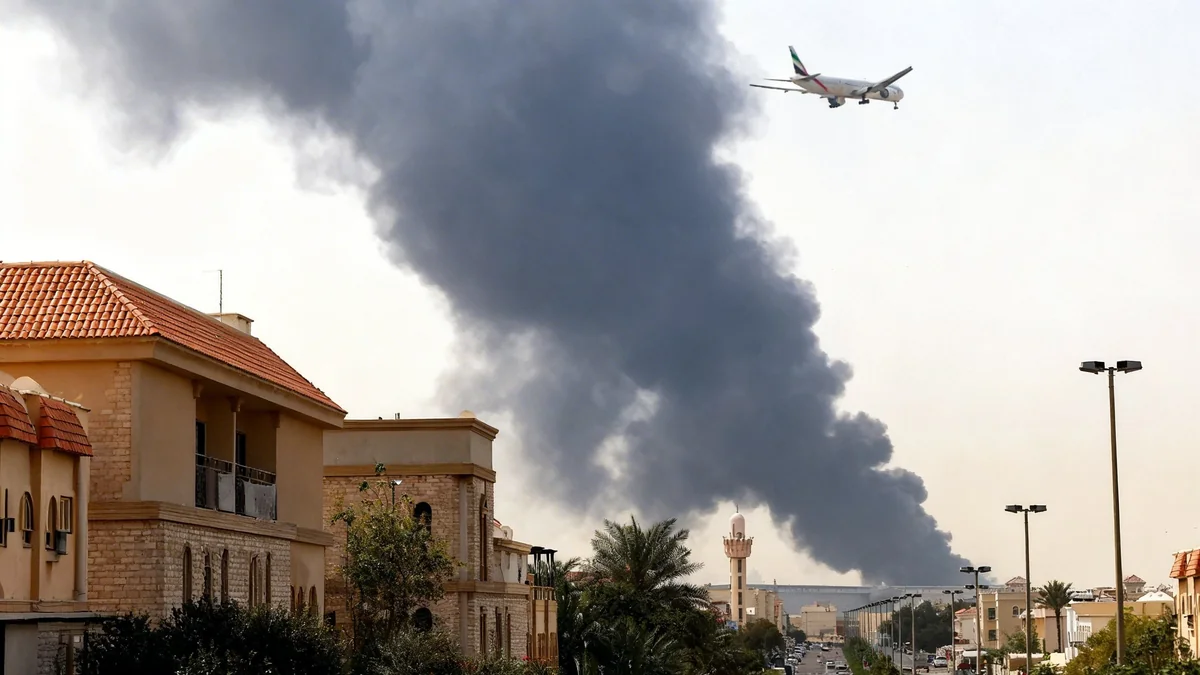
The Federal Aviation Administration has shut down airspace over a section of West Texas for nearly four months after the U.S. military downed a drone operated by Customs and Border Protection. The incident, which involved a laser weapon, has prompted sharp criticism from lawmakers and raised questions about coordination between federal agencies.
Key Takeaways
- The U.S. military shot down a U.S. Customs and Border Protection (CBP) drone near the Texas-Mexico border.
- In response, the FAA has closed the airspace near Fort Hancock, Texas, until June 24, citing "Special Security Reasons."
- Lawmakers are demanding an investigation, highlighting a critical lack of communication between the Pentagon, DHS, and the FAA.
- A preliminary report suggests CBP failed to notify the military of its drone's flight path, leading it to be identified as a potential threat.
Airspace Closed Over West Texas
An extensive portion of airspace near Fort Hancock, Texas, is now under a temporary flight restriction following an unusual incident on Thursday. The U.S. military confirmed it engaged and brought down an unmanned aircraft system that was later identified as belonging to U.S. Customs and Border Protection.
Following the event, the Federal Aviation Administration (FAA) issued a Notice to Airmen, or NOTAM, grounding all non-essential flights in the designated area. The restriction is scheduled to remain in effect until June 24, 2026, a nearly four-month period that underscores the seriousness of the situation.
The official reason provided for the shutdown is "Special Security Reasons." The notice requires any special flights, such as medical or search and rescue operations, to coordinate directly with the Albuquerque Air Route Traffic Control Center. The potential impact on regional commercial air travel remains unclear at this time.
A Pattern of Incidents
This is the second time this month that military activity has led to a sudden airspace closure in Texas. Earlier in February, the FAA shut down airspace over El Paso for 10 days, also for "Special Security Reasons." While the administration cited a "cartel drone incursion," subsequent reports suggested the military was testing a high-energy laser and may have targeted a party balloon.
A Breakdown in Coordination
Details emerging from Washington point to a significant failure in inter-agency communication. According to a preliminary internal report, CBP may not have informed the Department of Defense about its drone's flight plan. This lack of notification appears to have caused the military to perceive the friendly drone as an unknown and potentially hostile threat.
In a joint statement, the Pentagon, CBP, and the FAA acknowledged the incident. "This reported engagement occurred when the Department of War employed counter-unmanned aircraft system authorities to mitigate a seemingly threatening unmanned aerial system operating within military airspace," the statement read. The agencies added that the engagement occurred far from populated areas with no commercial aircraft nearby.
The statement also noted that the agencies are working together under presidential orders to "mitigate drone threats by Mexican cartels and foreign terrorist organizations at the U.S.-Mexico Border."
Lawmakers Demand Answers
The friendly-fire incident has drawn swift condemnation from members of Congress who oversee transportation and homeland security. Several high-ranking Democrats expressed alarm over the lack of coordination that led to the shootdown.
"Our heads are exploding over the news that DoD reportedly shot down a Customs and Border Protection drone using a high-risk counter-unmanned aircraft system," stated Representatives Rick Larsen, Bennie Thomson, and Andre Carson in a joint release.
The congressmen criticized the administration for not implementing a bipartisan bill designed to improve training for anti-drone weapon operators and establish clear protocols between the Pentagon, the Department of Homeland Security (DHS), and the FAA.
Senator Tammy Duckworth, a senior Democrat on the Senate's aviation subcommittee, also voiced her concern. "It’s this kind of failure to communicate between DoD and FAA that led to the tragic loss of life above DCA," she wrote. "This situation is alarming and demands a thorough, independent investigation." Senator Duckworth has called for the Inspectors General of the DoD, Department of Transportation, and DHS to launch a joint probe into the matter.
What is a NOTAM?
A Notice to Airmen (NOTAM) is a formal notice filed with an aviation authority to alert aircraft pilots of potential hazards along a flight route or at a location that could affect the safety of the flight. These are critical for operational safety and are issued for a wide range of reasons, including temporary airspace restrictions, runway closures, or equipment outages.
Unanswered Questions Remain
As the airspace over West Texas remains restricted, the incident leaves several critical questions unanswered. The primary focus for investigators will be determining the exact sequence of events that allowed a government drone to be targeted by the military. The effectiveness and safety protocols surrounding the use of advanced counter-drone systems, such as high-energy lasers, are also now under intense scrutiny.
For residents and aviators in the region, the long-term flight restriction introduces a new level of uncertainty. The outcome of the promised investigations will be crucial in restoring confidence and ensuring such a dangerous and costly mistake is not repeated.