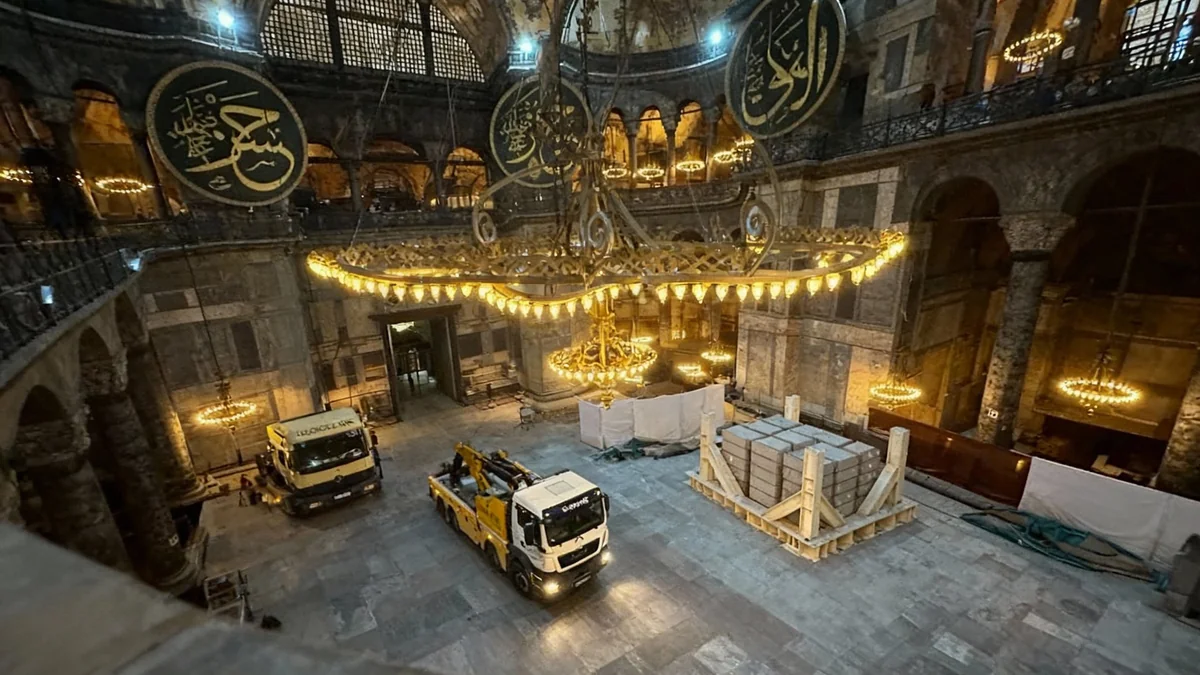
Turkish authorities are addressing public concerns regarding the use of heavy machinery inside the Hagia Sophia. Officials confirm that trucks and cranes are part of ongoing, carefully planned restoration efforts. These operations are designed to protect the monument's structure and precious mosaics during a multi-phase project.
Key Takeaways
- Heavy machinery is being used for a second-phase restoration of Hagia Sophia.
- The equipment helps install support columns for a temporary protective structure.
- Special access paths and reinforced flooring prevent damage to marble floors.
- All work follows scientific studies and expert committee decisions.
Protecting Ancient Mosaics
The General Directorate of Foundations announced that the machinery is essential for installing four 43.5-meter support columns. These columns will hold a temporary metal structure. This structure is crucial for protecting the mosaics located inside the monument's dome.
This work is part of a second-phase restoration. The project began in 2023. The goal is to safeguard the historical integrity of the Hagia Sophia while necessary conservation takes place.
Restoration Facts
- Column Height: Four support columns each measure 43.5 meters.
- Project Start: Second phase of restoration began in 2023.
- Purpose: To support a temporary structure protecting dome mosaics.
Minimizing Impact on Marble Floors
Authorities have taken specific steps to ensure the marble floors of Hagia Sophia remain undamaged. A special access path was created. This path allows vehicles to move without directly impacting the ancient stone.
The reinforced floor system is designed to handle significant weight. It can support up to 30 tons per square meter. The average pressure from the machinery currently in use is much lower, at only 6 tons.
“The goal is to take all necessary measures after studies to protect the monument’s underlying elements,” said Demetrios Athanasoulis, director of the Cyclades Antiquities Ephorate. He noted that large-scale restorations often require heavy equipment.
Scientific Approach to Conservation
Officials stress that all restoration activities are based on extensive scientific studies. Decisions are made by expert committees. This ensures that every step taken is in the best interest of the monument's long-term preservation.
The current restoration work also includes updating the lead coverings on the main dome. Additionally, smoke-absorbing devices are being used. These devices prevent engine fumes from spreading throughout the interior, protecting the air quality and the historic fabric of the building.
Hagia Sophia's History
Hagia Sophia, originally built as a cathedral in 537 AD, served as a Byzantine church for nearly a millennium. It was converted into a mosque after the Ottoman conquest of Constantinople in 1453. In 1934, it became a museum. In 2020, it was re-designated as a mosque, a decision that drew international attention.
Understanding the Scope of Restoration
Large-scale restoration projects, particularly for ancient and complex structures like Hagia Sophia, often require modern engineering solutions. The use of heavy equipment, while visually striking, is a practical necessity for installing large support structures and moving materials safely.
The careful planning and implementation, including reinforced flooring and protective pathways, highlight the commitment to preserving this UNESCO World Heritage site. The work aims to ensure the monument's stability and the protection of its invaluable artistic elements for future generations.
- Reinforced floor system supports up to 30 tons per square meter.
- Machinery pressure averages only 6 tons.
- Restoration includes updating main dome's lead coverings.
- Smoke-absorbing devices prevent engine fumes.
The ongoing efforts represent a significant investment in maintaining one of the world's most iconic buildings. Transparency from Turkish authorities helps clarify the necessity of these methods.