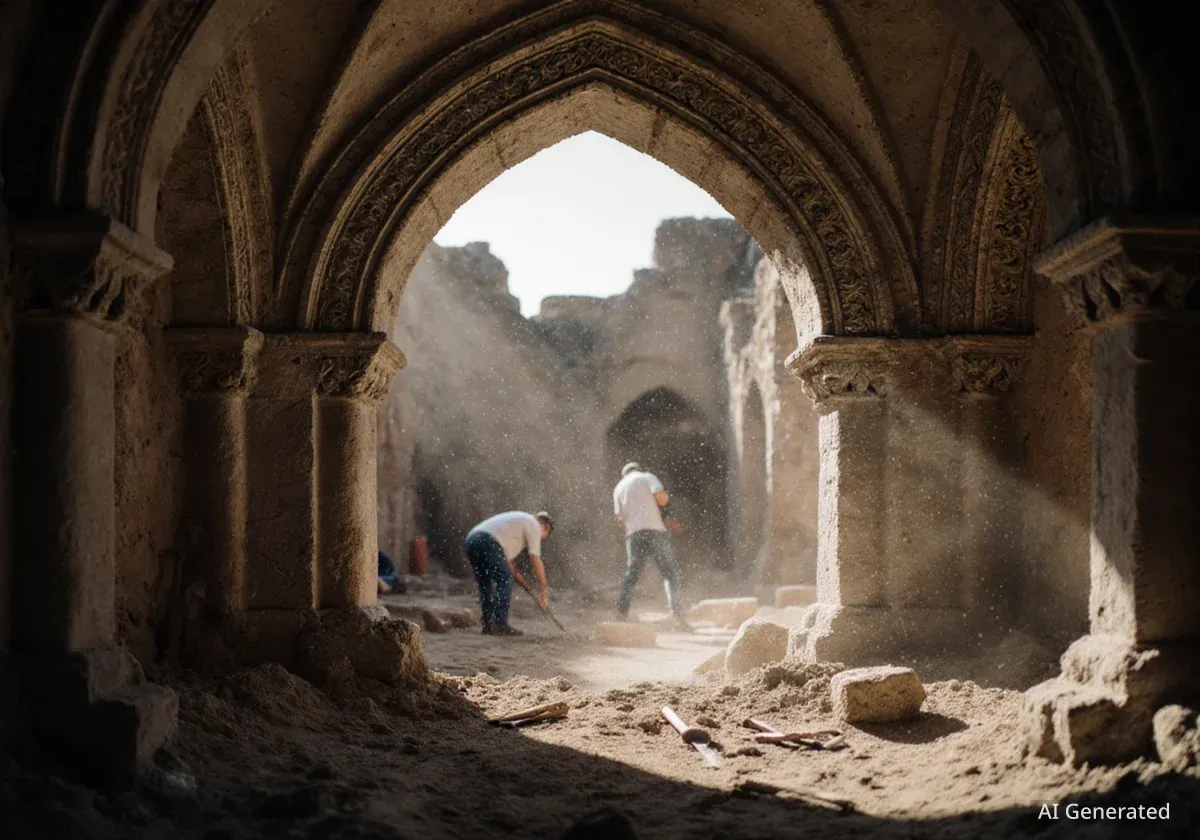
Archaeologists in Vannes, France, have made a significant discovery, unearthing the well-preserved ruins of a 14th-century castle. The Château de l'Hermine, built in the 1380s by Duke John IV of Brittany, was found beneath the courtyard of a private mansion, Hôtel Lagorce.
The unexpected find offers a rare glimpse into medieval ducal life and construction techniques, revealing an extensive structure complete with ornate facades, multiple rooms, and various artifacts dating back centuries.
Key Takeaways
- A 640-year-old castle, Château de l'Hermine, was discovered in Vannes, France.
- The castle belonged to Duke John IV of Brittany and was built in the 1380s.
- It was found beneath Hôtel Lagorce, a private mansion.
- Excavations revealed well-preserved structures and numerous daily life objects.
- The discovery highlights advanced medieval engineering and craftsmanship.
Discovery Under Hôtel Lagorce
The initial discovery occurred in 2021, when archaeologists began work ahead of the planned Vannes Museum of Fine Arts construction. The team from the National Institute for Preventive Archaeological Research (INRAP) did not anticipate finding such a significant historical site.
Further excavations in 2023 allowed researchers to better understand the scale and preservation of the castle's remains. The site revealed the ground floor of an imposing building, which archaeologists excavated to a height of one meter.
Quick Facts
- Year Built: 1380s
- Owner: Duke John IV of Brittany
- Location: Vannes, Brittany, France
- Discovery Year: 2021 (initial), 2023 (extensive excavation)
- Size of Ground Floor: 42 meters long, 17 meters wide
Architectural Grandeur and Layout
The unearthed ducal residence spans an impressive 42 meters in length and 17 meters in width. Its walls stand as high as 5.6 meters in some areas, indicating a multi-story structure. Researchers believe the castle likely had three or even four stories.
A central passageway runs through the building, connecting a north gate, which faced the town, to another gate. This second gate was flanked by two large towers built into the city wall and overlooked an outer moat. Old maps had previously hinted at these features, but their physical discovery confirms their existence.
"The excavations have revealed the ducal residence and its ornate façade, various rooms, and circulation areas, including several staircases," INRAP stated in a press release. "Archaeologists unexpectedly uncovered the ground floor of an imposing building, which they excavated to a height of one meter and which corresponds to the ducal residence."
Advanced Medieval Engineering
The construction quality of the Château de l'Hermine suggests that Duke John IV employed the finest engineers and craftsmen of his era. The thick walls and strategic placement directly bordered by a moat demonstrate sophisticated defensive and architectural planning.
An interesting feature is what archaeologists describe as a 'square tower' flanking the east side of the structure. This tower further emphasizes the castle's robust design and defensive capabilities.
Treasures of Daily Life
Beyond the structural remains, the excavation also yielded a rich collection of well-preserved objects. These artifacts provide direct insights into daily life within the castle during the 15th and 16th centuries.
Among the finds were coins, jewelry, and a variety of cooking utensils. Pots, pans, and roasting spits offer a glimpse into the culinary practices of the time. The damp environment of the site helped preserve several wooden items, including bowls and barrel fragments, which would typically decay quickly.
Historical Context
Duke John IV of Brittany ruled during a complex period in French history. His reign saw significant political maneuvering and military conflicts. Building a grand residence like the Château de l'Hermine was a way to assert his power and prestige within the region. The castle served not only as a home but also as a symbol of ducal authority.
Future Implications for Vannes
The discovery of the Château de l'Hermine significantly enriches the historical understanding of Vannes and the Brittany region. It adds another layer to the city's already deep medieval heritage. The site is expected to become a crucial focus for historical research and potentially a major attraction.
The planned Vannes Museum of Fine Arts, which prompted the initial archaeological survey, will now incorporate these significant findings. This ensures that the newly discovered castle will be integrated into the cultural narrative of the area for future generations.
- The castle's ground floor measures 42 meters by 17 meters.
- Walls reached heights of 5.6 meters.
- Artifacts include coins, jewelry, and cooking tools.
- Wooden items were preserved due to damp conditions.
- The discovery confirms advanced medieval craftsmanship.
The ongoing analysis of the site and its artifacts will continue to reveal more about the people who lived and worked within these walls centuries ago. This find stands as a testament to the hidden history often lying just beneath our feet.