Archaeologists in Budapest have made a significant discovery, unearthing a 1,700-year-old Roman sarcophagus that has remained hermetically sealed since its burial. The limestone coffin, found in the Óbuda district, contained the complete skeleton of a young woman and a remarkable collection of artifacts intended for her journey into the afterlife.
Key Takeaways
- A perfectly preserved Roman-era sarcophagus was discovered during excavations in Budapest, Hungary.
- The tomb, sealed for approximately 1,700 years, had never been opened or looted.
- Inside, researchers found the skeleton of a young woman along with numerous artifacts, including glass vessels, 140 coins, and jewelry.
- The discovery was made in Óbuda, the site of the ancient Roman city of Aquincum.
- Experts believe the woman was from a wealthy family due to the richness of the burial goods.
A Window into the Past
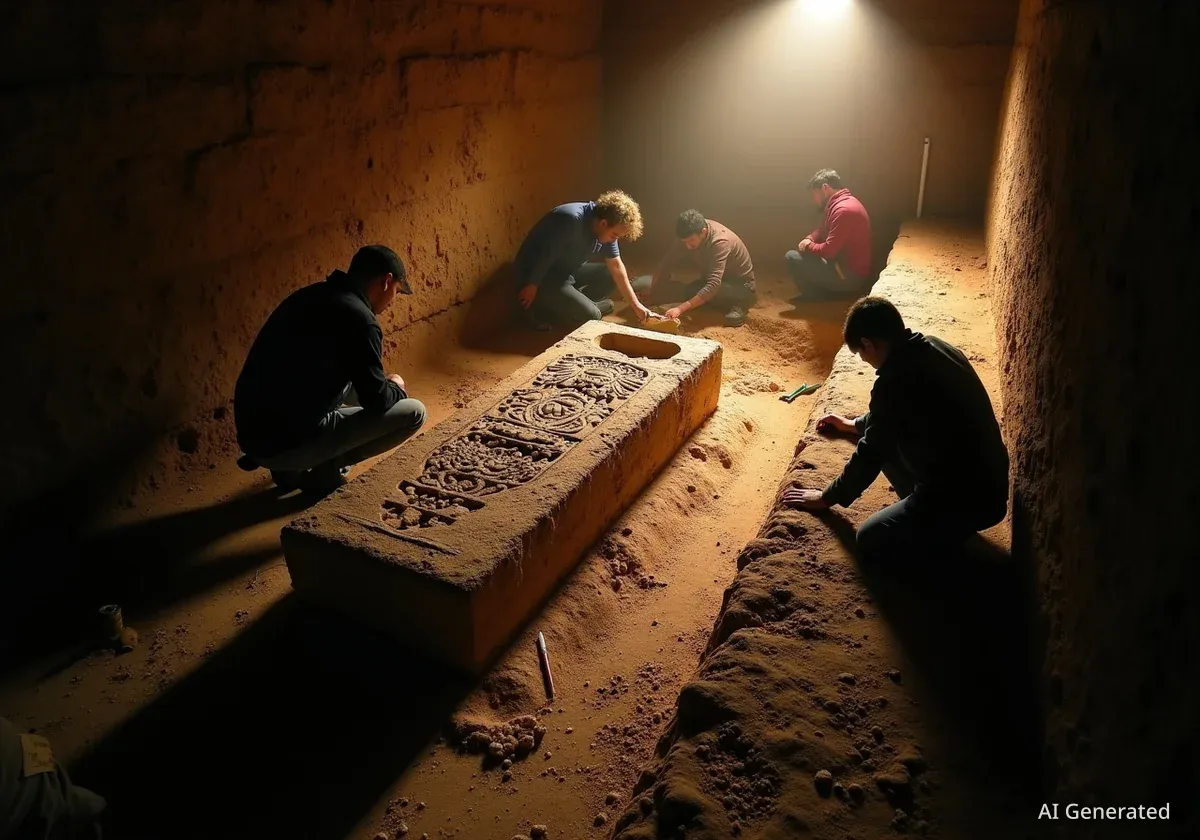
Excavations in a northern district of Budapest have revealed a direct link to the city's ancient Roman past. A team from the Budapest History Museum uncovered a heavy limestone sarcophagus that was found to be completely intact, a rarity for archaeological finds of this nature. The coffin was secured with iron clamps and molten lead, a method that successfully protected its contents for nearly two millennia.
The discovery was made in an area that was once part of Aquincum, a major Roman settlement and military base on the Danube frontier. The sarcophagus was located among the ruins of abandoned 3rd-century houses, in a section of the city that was later repurposed as a cemetery.
"The peculiarity of the finding is that it was a hermetically sealed sarcophagus. It was not disturbed previously, so it was intact," stated Gabriella Fényes, the lead archaeologist on the excavation.
The team carefully opened the heavy lid to reveal a scene untouched by time. Inside lay the skeleton of a young woman, surrounded by items her relatives had packed to accompany her to the next world.
The Roman City of Aquincum
During the Roman Empire, much of present-day Hungary was part of the province of Pannonia. Aquincum, located on the Danube River, served as a crucial military outpost and the capital of Pannonia Inferior. It was home to a legionary fortress and a bustling civilian town with a population that may have reached 40,000. The site of the discovery is less than a mile from the river, which formed the empire's heavily fortified border.
Treasures for the Afterlife
The contents of the sarcophagus provide a detailed glimpse into the burial customs and material wealth of the Roman era. The young woman was buried with a significant collection of personal and valuable items. Researchers cataloged an impressive array of artifacts placed carefully around her remains.
Among the key findings were:
- Glassware: Two perfectly preserved glass vessels, likely used for perfumes or oils.
- Coins: A collection of 140 coins, which would have been considered a substantial sum.
- Jewelry and Adornments: A bone hairpin, amber jewelry, and traces of fabric with gold threads.
- Figurines: Several small bronze figures were also included in the burial.
Gergely Kostyál, a Roman-period specialist and co-leader of the project, noted the significance of these items. "This probably means that the deceased was well-to-do or of a higher social status," he explained. The sheer quantity and quality of the goods suggest her family invested heavily in her burial.
A Unique Find: According to Kostyál, it is "truly rare" to find a sarcophagus that was never reused. In the 4th century, it was common practice to empty and reuse older coffins. The fact that this one was custom-made and used only once for this burial highlights its importance.
Uncovering a Personal Story
The arrangement of the items and the care taken in sealing the tomb have left a deep impression on the research team. "The deceased was buried very carefully by her relatives. They must have really loved who they buried here," Fényes commented.
The size of the skeleton, along with the specific types of artifacts like the hairpin and jewelry, led archaeologists to conclude the remains belong to a young woman. Anthropologists will now conduct a thorough analysis of the bones to determine her approximate age, potential health conditions, and possibly her origins.
"I was very touched by the care and expression of love that we were able to get a glimpse of. Even now, I shudder to think how painful it must have been for the people at that time to bury this young lady," Fényes added.
More Secrets to Reveal
The investigation is far from over. The team also removed a layer of mud, about four centimeters thick, from the bottom of the sarcophagus. This sediment will be carefully sifted in a laboratory environment, as it may contain smaller items that are not immediately visible.
Fényes is optimistic about what they might find. "I suspect we could find jewellery. We haven't found any earrings or other jewellery belonging to the woman, so I hope that these small items will turn up during the sifting of the mud," she said.
This discovery, alongside eight other simpler graves and a Roman aqueduct found nearby, continues to build a more complete picture of life and death in Aquincum. It stands as a poignant and scientifically valuable time capsule, offering a rare, undisturbed look at the personal world of a young woman who lived and died on the edge of the Roman Empire 1,700 years ago.