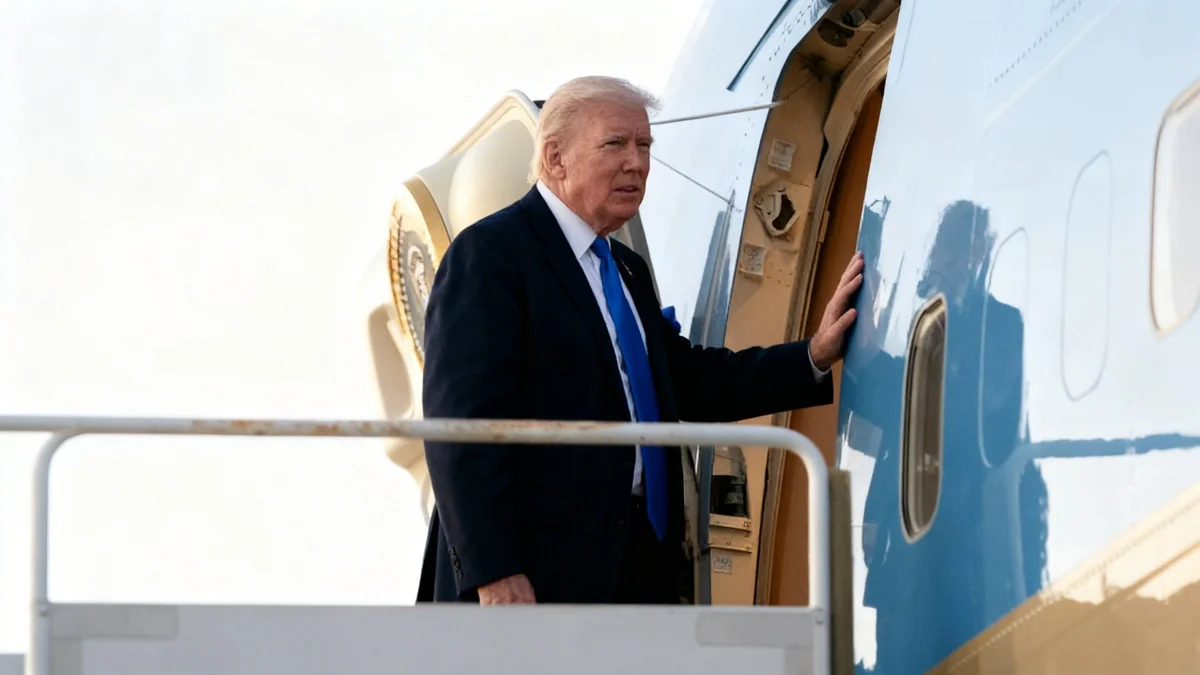
The Florida Legislature has approved a bill to rename Palm Beach International Airport after President Donald J. Trump, a move that now awaits the governor's signature but faces federal hurdles and is already causing significant disruption for local residents due to new flight restrictions.
If the proposal moves forward, the airport could be officially known as Donald J. Trump International Airport as early as July 1, 2026. However, the plan requires final approval from the Federal Aviation Administration (FAA) and a formal rights agreement with the Trump Organization.
Key Takeaways
- Both houses of the Florida Legislature have passed a bill to rename Palm Beach International Airport (PBI) after Donald J. Trump.
- The renaming requires approval from Governor Ron DeSantis, the FAA, and a rights agreement with the Trump Organization.
- A permanent no-fly zone around the Mar-a-Lago residence has already forced flight path changes, affecting thousands of homes with increased noise.
- The Trump Organization has filed trademark applications for airport-related names, including the code "DJT," but states it will not seek financial compensation.
Legislative Approval and Federal Hurdles
State lawmakers in Florida have given their support to the proposal, passing the measure through both the House and Senate this week. The next step is for the bill to be signed into law by Governor Ron DeSantis. Even with state-level approval, the process is far from complete.
The Federal Aviation Administration must also consent to the name change, a standard procedure for any U.S. airport. Additionally, an agreement must be reached with the Trump Organization, which holds the rights to the Trump name for commercial use. This step introduces a layer of private business negotiation into a public infrastructure project.
A History of Presidential Airports
Naming airports after presidents is a common practice in the United States, but it typically occurs after they have left office or posthumously. For example, Washington National Airport was renamed for Ronald Reagan in 1998, and Houston's airport was renamed for George H.W. Bush in 1997. New York International Airport was famously renamed for John F. Kennedy just one month after his assassination in 1963.
Trademarks Filed Amid Financial Assurances
Adding a unique dimension to the proposal, business entities associated with Donald Trump have filed applications with the United States Patent and Trademark Office. These filings seek to secure rights to potential airport names and even the airport identifier code "DJT."
Despite these commercial filings, the Trump Organization has issued a public statement addressing potential financial arrangements. According to the organization, "the president and his family will not receive any royalty, licensing fee or financial consideration whatsoever from the proposed airport renaming." This assurance aims to separate the honorary renaming from any direct business profit.
Opponents of the measure, however, remain focused on the federal aspects of the change. Democratic leaders have indicated they will appeal to the FAA to retain the airport's existing three-letter code, PBI, which is under federal jurisdiction.
Local Disruption from New Flight Restrictions
For residents living near Palm Beach International, the political debate is secondary to a more immediate concern: constant aircraft noise. The controversy stems from a permanent no-fly zone established around the Mar-a-Lago club, located just 2.5 miles from the airport's main runway.
Last October, the FAA implemented a one-nautical-mile restricted airspace around the residence at all times. This zone expands to a 10-nautical-mile radius whenever the President is in town. Previously, these restrictions were only active during his visits.
Impact by the Numbers
- 11,000: The number of homes located within the newly established permanent flight paths.
- 5 square miles: The area covered by the redirected aircraft routes.
- 4x: The new flight paths impact four times as many people as the previous, temporary routes.
To avoid violating the no-fly zone, arriving and departing aircraft must now execute sharp turns. These new flight paths extend over a densely populated five-square-mile area, bringing the roar of jet engines to approximately 11,000 homes. While residents had previously tolerated the noise during temporary presidential visits, its conversion into a permanent feature has led to widespread frustration.
A Familiar Political Battle
This is not the first attempt to name a major airport after President Trump. In 2025, after he returned to office, an effort was made to rename Washington Dulles International Airport in his honor. That proposal required congressional approval, which ultimately failed to materialize.
At the time, the White House reportedly attempted to leverage federal funding for a critical rail project in New York to gain support from Senate Minority Leader Chuck Schumer, who did not yield to the pressure. A court later deemed the freezing of funds illegal.
With the Dulles effort unsuccessful, supporters have turned their attention to Florida, where there is more significant political alignment. While the state can change the name, the final decision on operational details and federal compliance rests with agencies in Washington, D.C., setting the stage for another potential political showdown.