
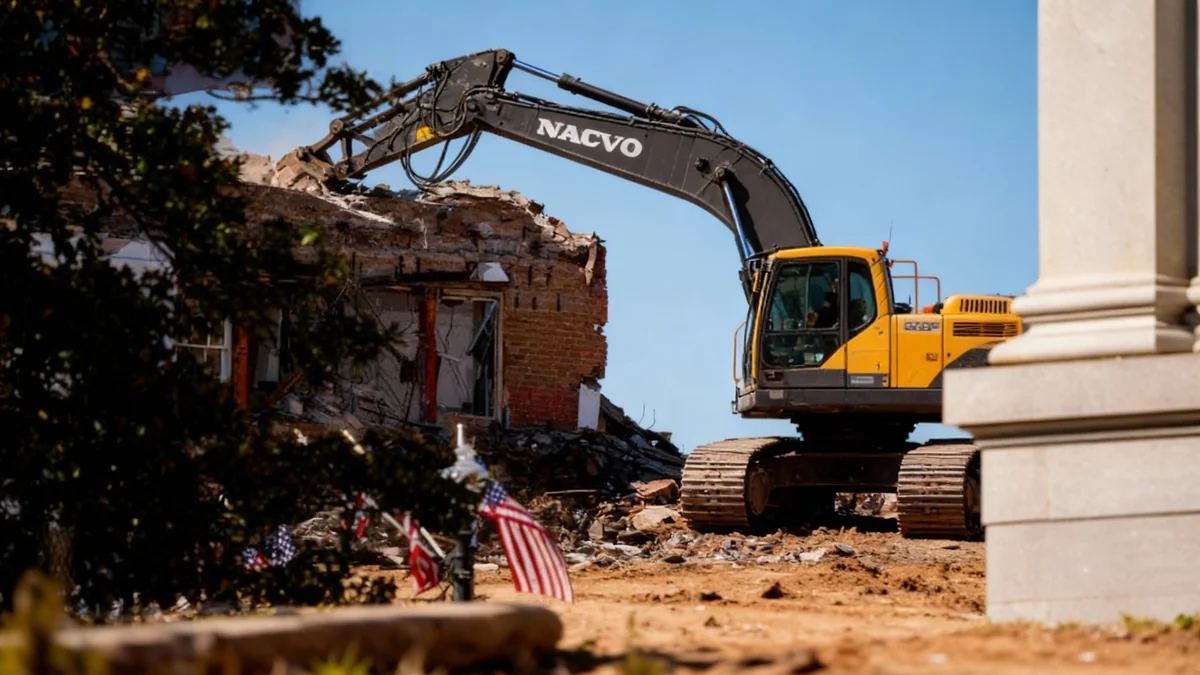
The demolition of the East Wing of the White House has drawn strong criticism from architectural and preservation groups. These organizations are concerned about the lack of public review and the proposed 90,000-square-foot ballroom intended to replace the historic structure.
The National Trust for Historic Preservation has called for an immediate halt to the demolition work. They argue that the sheer size of the new ballroom could significantly alter the White House's classic design.
Key Takeaways
- Demolition of the White House East Wing is underway.
- A 90,000-square-foot ballroom is proposed to replace it.
- Preservation groups are concerned about the project's scale and lack of public review.
- The National Trust for Historic Preservation has demanded a halt to work.
- The White House defends the changes as part of a long tradition of renovations.
Preservation Groups Demand Public Review
Carol Quillen, president and CEO of the National Trust for Historic Preservation, expressed deep concern in a letter to key commissions. She highlighted that the proposed ballroom's massing and height might overwhelm the original White House structure. The main Executive Mansion itself measures 55,000 square feet, making the proposed 90,000-square-foot ballroom significantly larger.
The East Wing has historically served as the entry point for most White House visitors and tourists. It also houses offices for the first lady and social secretary. Its removal marks a substantial change to the complex.
"We are deeply concerned that the massing and height of the proposed new construction will overwhelm the White House itself... and may also permanently disrupt the carefully balanced classical design of the White House," Carol Quillen stated.
Quillen emphasized the need for the ballroom project to undergo a legally required public review process. This process involves the National Capital Planning Commission and the Commission of Fine Arts. Public input is also a crucial part of this review.
Fact Check
- The proposed ballroom is 90,000 square feet.
- The main White House Executive Mansion is 55,000 square feet.
- The East Room currently accommodates about 200 people.
- The new ballroom could potentially hold 900 people.
White House Defends Renovations
The White House has responded to the criticism by issuing a press release. They pointed to a long history of presidential alterations and expansions to the White House complex. They described the current outcry as "manufactured outrage" from "unhinged leftists and their Fake News allies."
The administration views the new ballroom as a "visionary addition." They state it echoes a "storied history of improvements and renovations from commanders-in-chief to keep the executive residence as a beacon of American excellence."
Historically, significant renovations have occurred. In 1948, under President Harry Truman, the entire Executive Mansion was gutted down to its exterior walls. This was part of a major renovation project prompted by fears that the building was structurally unsound.
Historical Context
The White House has undergone numerous changes since its initial design in 1792. These range from minor cosmetic updates to extensive structural overhauls. President Truman's 1948 renovation was one of the most drastic, essentially rebuilding the interior of the Executive Mansion while preserving its historic facade.
The Need for Larger Event Space
President Trump has frequently voiced concerns about the White House's lack of a large event space. Most official functions currently take place in the East Room, which can only accommodate around 200 guests. Larger state dinners often require setting up tents on the South Lawn.
The new ballroom aims to address this limitation. President Trump has indicated that it could potentially host up to 900 people. This would significantly expand the White House's capacity for official events and gatherings.
Plans for the ballroom were first revealed last summer. At that time, President Trump stated it would not "interfere with the current building." However, the scale of the proposed project made it clear that the East Wing would need substantial alteration.
Proposed Changes to the East Room
More recently, President Trump indicated that an alteration would be made to the East Room itself. This room is part of the main White House executive mansion. The plan includes a new access point connecting the East Room to a newly constructed corridor, which would lead to the new ballroom.
The American Institute of Architects (AIA) previously issued a statement regarding the project. They emphasized that any new ballroom "must harmonize with the White House’s scale and architecture, ensuring the final design complements its historic character."
Concerns Across the Political Spectrum
The images of the East Wing's demolition have sparked widespread discussion. While some see it as a metaphor for broader changes, concerns are not limited to one political side.
Byron York, chief political correspondent for the Washington Examiner, posted on X, urging transparency. He stated, "The president needs to tell the public now what he is doing with the East Wing of the White House. And then tell the public why he didn’t tell them before he started doing it." This highlights a desire for more public communication regarding the project.
The funding for the new ballroom is expected to come from private donations. This approach has also been a point of discussion, though the primary focus remains on the structural and historical implications of the demolition and new construction.
During the Obama administration, then-businessman Trump reportedly offered assistance in building a ballroom. However, the Obama administration did not pursue the offer, according to David Axelrod, a former senior adviser to President Obama.
The ongoing demolition and proposed construction will likely continue to generate debate. The balance between modern functional needs and historical preservation remains a central theme in the discussion surrounding the White House East Wing project.