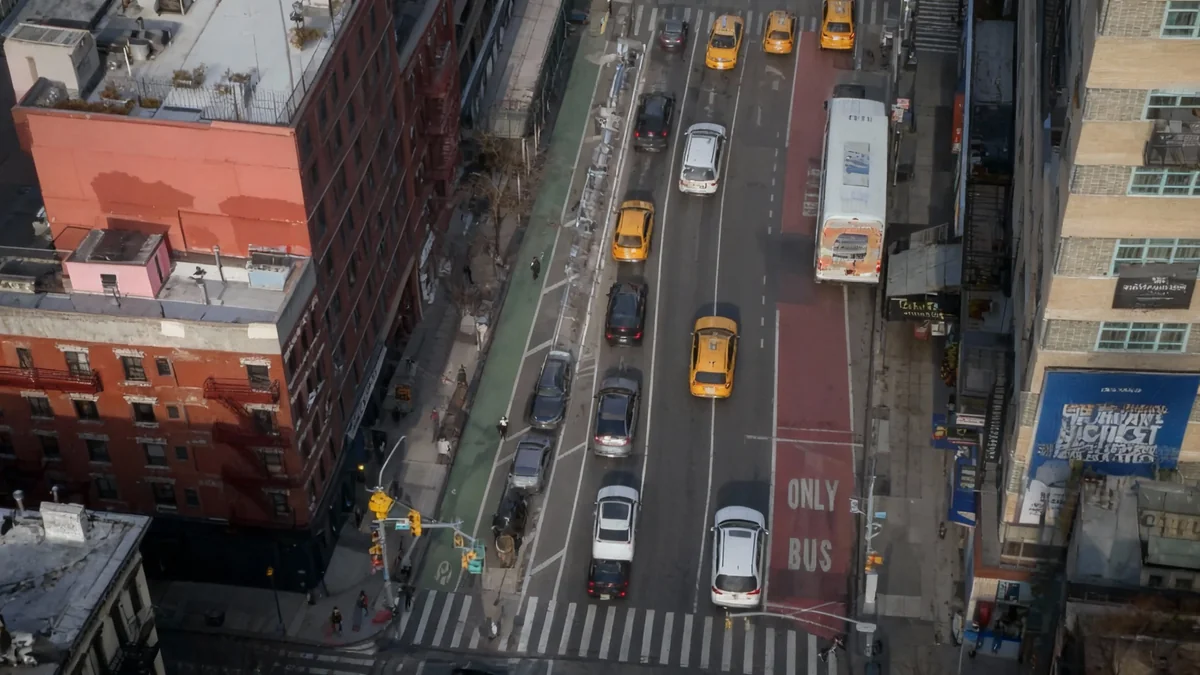
New York City's congestion pricing program, launched in January 2025, is producing unexpected results that extend far beyond Manhattan's central business district. A recent study reveals that the largest share of time saved from reduced traffic is not benefiting drivers entering the city, but rather those in the surrounding suburbs and outer boroughs.
Key Takeaways
- A new study found that drivers outside Manhattan's toll zone collectively save over five times more travel time than those driving into it.
- Suburban and outer borough drivers saved a combined total of more than 461,000 hours per week.
- Fears of traffic displacement to areas like the Bronx and Staten Island have not materialized; instead, roadways throughout the region have seen modest speed improvements.
- The findings suggest that congestion pricing creates a ripple effect, easing traffic on feeder highways and local roads far from the city center.
An Unexpected Ripple Effect
When New York City implemented its $9 peak-hour toll for vehicles entering the central business district, the primary goal was clear: reduce gridlock on Manhattan's notoriously clogged streets. Data confirms the program is working as intended, with faster trips for taxis, buses, and cars within the congestion zone.
However, a new working paper from the National Bureau of Economic Research (NBER) highlights a far broader and more surprising benefit. Researchers analyzing anonymized trip data discovered that the policy's positive effects are not contained within Manhattan. The majority of time savings are being realized by drivers who never even enter the toll zone.
The study, which reviewed travel patterns from September 2024 to June 2025, provides the first comprehensive look at the program's region-wide impact. It isolates the effects of congestion pricing by comparing traffic trends in the New York tri-state area with those in other major U.S. cities.
Time Saved by the Numbers
- Inside the Toll Zone: Drivers entering Manhattan saved a total of 83,000 hours per week.
- Outside the Toll Zone: Drivers in suburbs and outer boroughs saved a combined 461,000 hours per week.
- Average Trip Savings: While Manhattan-bound trips became about three minutes faster, the average non-Manhattan trip sped up by only eight seconds. The sheer volume of these shorter trips created the massive overall time savings.
How Suburban Commutes Got Faster
The logic behind this phenomenon is straightforward. By discouraging a percentage of drivers from entering Manhattan during peak hours, the program reduces the number of cars on major arteries leading into the city. Highways in New Jersey, Long Island, and Westchester see less volume, which in turn frees up capacity for all drivers using those roads.
This includes commuters traveling between suburbs, such as from Bergen County to Queens, or residents running local errands. While an individual driver might only save a few seconds, the cumulative effect across millions of trips is substantial. For example, the study found that car trips on Long Island sped up by an average of 2.3%.
Cody Cook, a Yale economist and one of the study's lead authors, explained that the impact is strongest on highways near Manhattan and gradually lessens further away. "As we look farther and farther from the central business district, the effects on speeds become increasingly small as there are fewer and fewer CBD-bound drivers," Cook noted.
Refuting Earlier Concerns
One of the main arguments against congestion pricing was the fear that it would simply push traffic congestion into other areas. Critics predicted that drivers avoiding the toll would clog local streets in boroughs like the Bronx and on Staten Island. The NBER paper found no evidence to support this claim. Instead, the data suggests "the policy reduced overall traffic volumes rather than simply displaced congestion."
A New Narrative for Congestion Pricing
These findings could reshape the political conversation around congestion pricing, both in New York and in other cities considering similar measures. For years, the debate has often pitted urban centers against suburbs, with many suburban residents viewing the tolls as a penalty for their occasional trips into the city.
"There is a really strong case for everyone in New Jersey to care about this, even if you’re not going to be using the tunnel." – Kate Slevin, Regional Plan Association
Kate Slevin, executive vice president at the Regional Plan Association, has been a long-time advocate for the policy. She acknowledged that even proponents rarely emphasized the potential benefits for drivers outside Manhattan. Slevin believes many suburban drivers are likely unaware that their daily commutes have improved because of the program.
"Individually, it’s not that much time, so you might not recognize it," she said. However, she added that having concrete data to demonstrate these widespread benefits could be a powerful tool for future advocacy efforts.
Lessons for Other American Cities
The New York experience offers a compelling case study for other metropolitan areas struggling with traffic. The NBER researchers identified Boston and Chicago as two regions that could see similar, widespread benefits from a congestion pricing system. Both cities have leaders who have already explored the possibility of such tolls.
Clifford Winston, a senior fellow at the Brookings Institution who was not involved with the research, described the NBER study as "careful" and its conclusions "credible." He believes the positive outcomes seen in New York could be replicated in other major urban areas.
The key takeaway is that reducing traffic at the core of a region doesn't just help those traveling to the center. It creates a cascade of small improvements that benefit a much larger population, turning a controversial urban policy into a regional solution for traffic relief.