
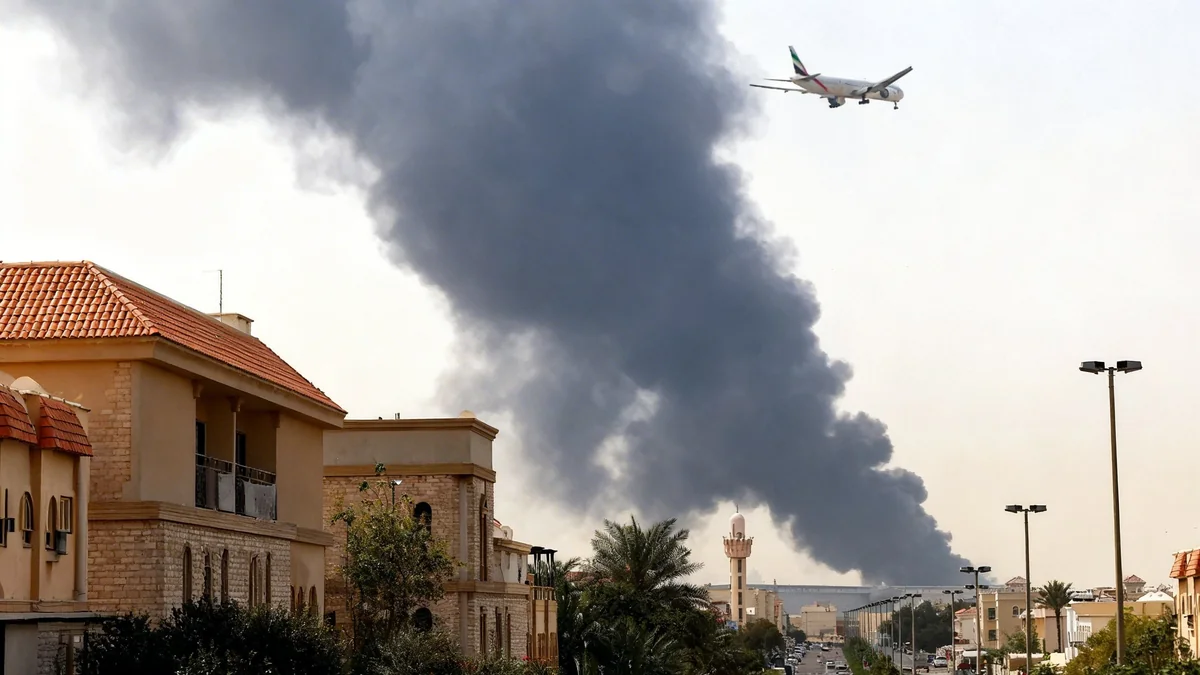
Dubai's main international airport, one of the world's busiest aviation hubs, resumed operations on Monday following a drone-induced fuel tank fire. The incident caused significant disruption, leading to a multi-hour suspension of flights and impacting travel schedules for thousands of passengers.
Emirates, the state-owned carrier, began a limited flight schedule after 10 a.m. local time. This marked the longest operational halt at Dubai International Airport since the implementation of "safe air corridors" three days into the ongoing Iran conflict.
Key Takeaways
- Dubai International Airport halted operations for over seven hours.
- A drone strike caused a fuel tank fire, leading to the disruption.
- Emirates resumed a limited flight schedule Monday morning.
- This is the longest halt since "safe air corridors" were established.
Drone Strike Triggers Airport Closure
The incident unfolded on Monday morning when an unmanned aerial vehicle, or drone, struck a fuel tank on airport grounds. The impact ignited a fire, prompting immediate action from emergency services and airport authorities. The safety protocols initiated led to a complete suspension of all flight operations.
Airport officials confirmed the closure to prioritize passenger safety and allow firefighters to control the blaze. The rapid response helped contain the fire, preventing it from spreading to other critical areas of the airport infrastructure.
Incident Details
- Date: March 16, 2026
- Cause: Drone strike on a fuel tank
- Duration of Halt: Over seven hours
- Affected Carrier: Emirates (canceled some flights)
Impact on Global Travel Hub
Dubai International Airport (DXB) serves as a critical connection point for global air travel. Its closure had far-reaching effects, impacting flights across continents. Many international flights were either diverted or delayed, creating a ripple effect throughout the global aviation network.
Thousands of passengers found themselves stranded at the airport or at various transit points. Airlines worked to rebook passengers and provide accommodations where possible, though the sudden nature of the closure presented significant logistical challenges.
"The safety of our passengers and staff remains our utmost priority," an airport spokesperson stated, emphasizing the necessity of the operational halt during the emergency.
Emirates Restarts Limited Schedule
Emirates, one of the world's largest airlines and the primary operator from Dubai, faced substantial cancellations. Following the airport's partial reopening, the airline began a phased resumption of services. This involved prioritizing certain routes and gradually increasing flight frequency.
Passengers traveling with Emirates were advised to check their flight status regularly. The airline indicated that it would take time to fully restore its schedule and clear the backlog of affected travelers.
Geopolitical Context
This incident occurs amidst a period of heightened regional tension due to the prolonged Iran war. Dubai has maintained "safe air corridors" to ensure continued travel and trade, making any disruption particularly sensitive. The drone strike raises questions about airspace security in the region.
Aviation Security Concerns
The drone incident highlights growing concerns about aviation security and the threat posed by unmanned aerial vehicles. Drones, whether intentionally or accidentally, can pose significant risks to airport operations and aircraft safety.
Airports worldwide are increasingly investing in counter-drone technologies and protocols. This incident in Dubai is expected to further accelerate discussions and implementations of advanced defense systems to protect critical infrastructure from such threats.
Lessons for Airport Safety
The swift response of Dubai's emergency services and airport management in containing the fire and resuming operations is notable. However, the incident underscores the vulnerability of even the most advanced airports to unexpected aerial threats. It serves as a stark reminder for aviation authorities globally to continuously review and enhance their security measures.
Industry experts suggest that integrating advanced radar systems, drone detection technologies, and rapid interception capabilities will become standard practice. The goal is to create a multi-layered defense against both malicious and accidental drone intrusions.
Future of Air Travel in Challenging Times
The incident in Dubai adds another layer of complexity to an already challenging environment for air travel. Geopolitical tensions, coupled with technological threats, demand constant vigilance from the aviation sector.
Despite the disruption, Dubai's airport infrastructure demonstrated resilience in resuming operations relatively quickly. This event will likely lead to a comprehensive review of existing security protocols and an accelerated adoption of new technologies to safeguard one of the world's most vital air travel arteries.
The focus remains on ensuring uninterrupted and safe passage for travelers, even as the global landscape presents new and evolving challenges to aviation security.