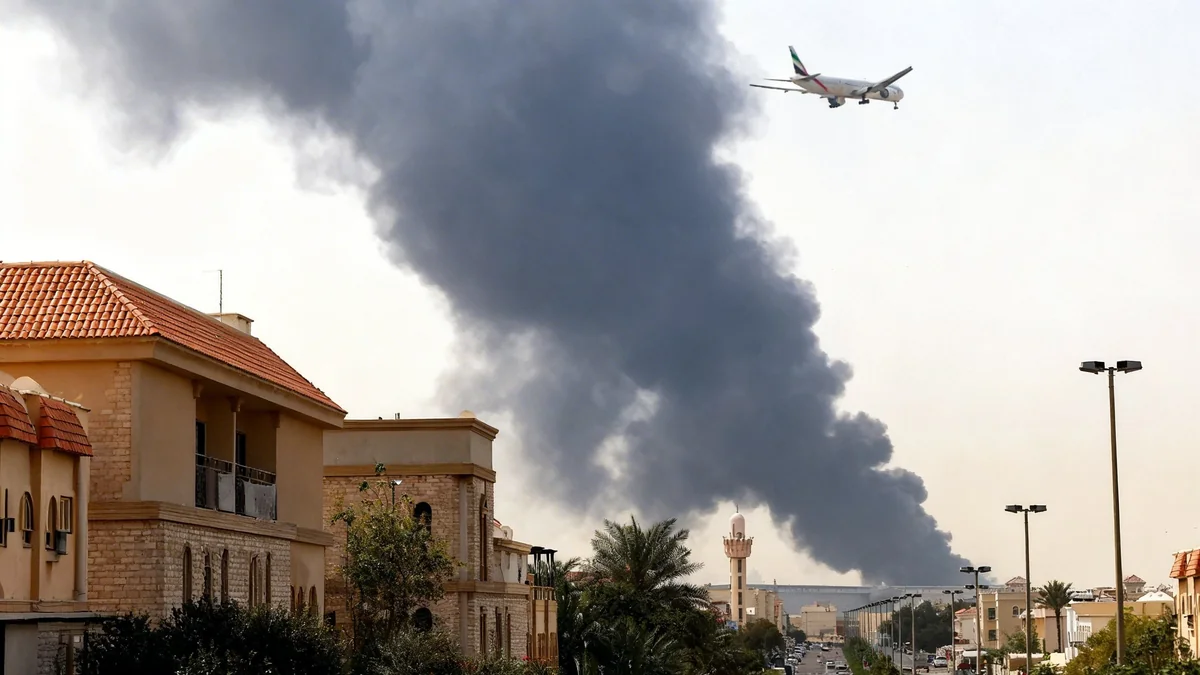
Airports across the Middle East have suspended flight operations, leaving thousands of travelers stranded. This widespread disruption follows recent air strikes in the region, leading to closed airspace and numerous flight cancellations. Major hubs like Dubai, Doha, and Abu Dhabi, critical for global connecting traffic, are at the center of the chaos.
Key Takeaways
- Middle Eastern airspace closures have halted flights at major hubs.
- Thousands of passengers are stranded in airports and on diverted flights.
- Airlines are suspending routes and rerouting flights globally.
- Travelers face long waits for information and accommodation.
Mass Cancellations Impact Global Travel
The closures began on Saturday, affecting a significant portion of international air travel. Data from aviation analytics firm Cirium indicates that Emirates, Qatar Airways, and Etihad Airways alone transport approximately 90,000 transit passengers daily through their home airports. This figure does not include those whose final destination is within the Middle East, meaning the total number of affected individuals is much higher.
Travelers attempting to reach the Middle East from distant locations, such as London and the United States, have also experienced cancellations or mid-journey diversions. Many now find themselves in crowded terminals, unsure when they can resume their journeys.
Impact at a Glance
- 90,000+ daily transit passengers affected by major Middle Eastern carriers.
- Airspace closures are 'until further notice' for many regions.
- Lufthansa Group suspended flights to 8 key destinations and several airspaces.
Passenger Accounts of Airport Chaos
Jaiveer Cheema, an Emirates passenger, described the situation at Dubai International Airport. He was scheduled to fly to the US on Saturday. Cheema reported being stuck on his plane for five hours without food before passengers were deplaned into a crowded terminal.
"The next several hours at the airport were chaos as no one knew what to do," Cheema stated. "We spoke to several security guards and Emirates employees, and they all gave us different answers."
Cheema spent hours in various lines before eventually securing a hotel voucher and a bus transfer. However, he was still waiting for a room 90 minutes after arriving at the lodging, nearly 20 hours after his initial 9 a.m. flight check-in. He also noted that Emirates had not provided clear information about his onward travel.
Long Waits and Unanswered Questions
The experience of passengers like Cheema highlights the confusion and lack of immediate solutions. Airlines are advising travelers via social media to expect significant wait times for customer service and at airport facilities. The sheer scale of displaced passengers and aircraft is expected to cause a ripple effect globally if operations do not resume quickly.
Regional Significance
Dubai, Doha, and Abu Dhabi are vital global aviation hubs, connecting East and West. Their temporary closure creates bottlenecks that impact routes worldwide, affecting travelers far beyond the immediate region. These airports serve as critical transfer points for millions of passengers annually.
Airlines Reroute and Suspend Services
Airlines are rapidly adjusting their operations in response to the closed airspaces. Lufthansa Group announced the suspension of flights to Beirut, Tel Aviv, Amman, Erbil, and Tehran until March 7. The company also confirmed that several airspaces would not be used during this period, including Israel, Lebanon, Jordan, Iraq, Qatar, and Iran.
Additionally, Lufthansa Group airlines have suspended flights to and from Dubai, Abu Dhabi, Riyadh, and Dammam until March 1. The airspace of the United Arab Emirates will also remain unused until March 1.
Impact Beyond the Middle East
The disruption extends to airports far from the Middle East. London Gatwick Airport, for instance, reported expected disruptions to its Qatar Airways and Emirates flights. Departure boards in London showed cancellations for flights heading to the affected region.
Tribhuvan International Airport in Nepal issued an advisory stating that international flights might face delays, rescheduling, or cancellations due to airspace restrictions. Passengers flying with major carriers like Qatar Airways and Turkish Airlines were advised to contact their airlines directly for updates.
Airport Responses and Passenger Safety
Hamad International Airport in Qatar confirmed the temporary suspension of all aircraft movement due to the country's closed airspace. The airport emphasized passenger and employee safety as its top priority.
"Our priority is always the safety of our passengers and employees. We are working closely with government stakeholders and airline partners to look after passengers that have been impacted," the airport stated in an advisory.
The situation remains fluid, with airports and airlines working to manage the evolving crisis. Travelers planning journeys through or to the Middle East are strongly advised to check their flight status directly with their airline and airport before traveling.
- Check flight status frequently.
- Contact airlines directly for rebooking options.
- Be prepared for extended wait times at airports.