
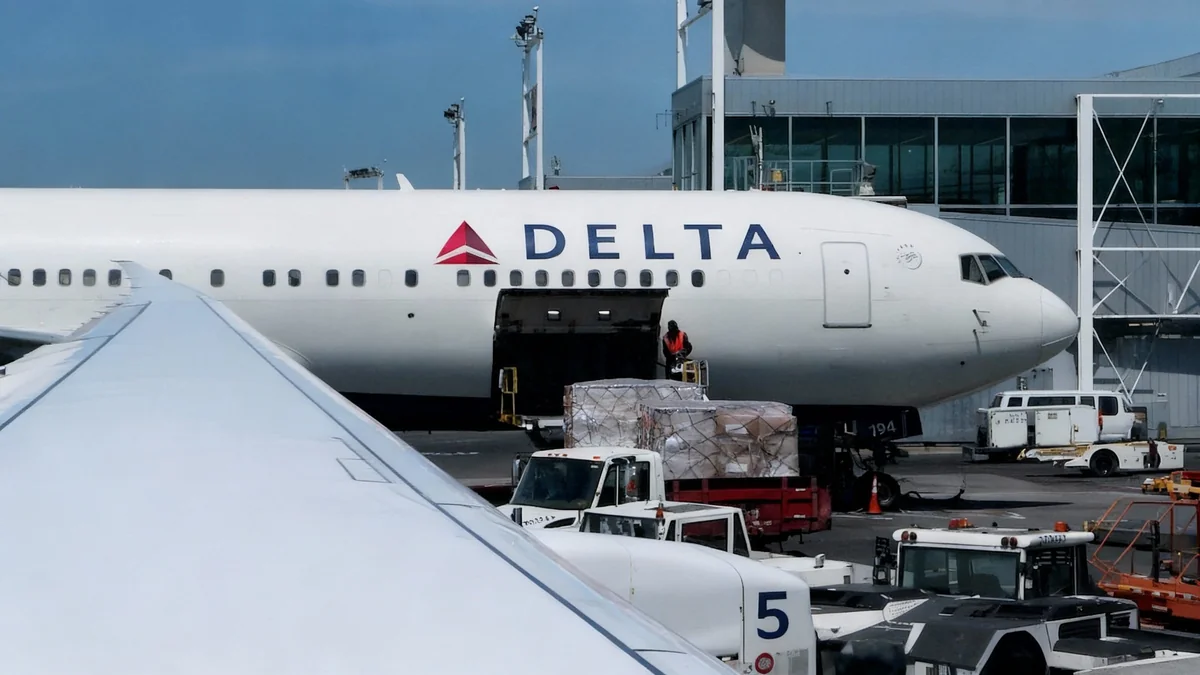
Delta Air Lines is projecting a significant earnings increase of approximately 20% in 2026, driven primarily by strong demand from higher-income and corporate travelers. This forecast comes as the airline simultaneously announced an order for 30 Boeing 787 widebody jets, with options for 30 more, signaling a strategic move to bolster its long-haul fleet and diversify its aircraft suppliers.
The Atlanta-based carrier's outlook highlights a distinct trend in the current U.S. economy, often described as K-shaped. While affluent consumers continue to spend freely on travel, price-sensitive passengers are showing signs of restraint. This economic disparity is shaping Delta's business strategy.
Key Takeaways
- Delta anticipates 20% earnings growth by 2026, fueled by premium and corporate travel.
- The airline ordered 30 Boeing 787-10 widebody jets, with options for 30 more.
- Main cabin revenue decreased by 7% in the December quarter, while premium revenue rose 9%.
- Nearly 60% of Delta's revenue now comes from premium products, loyalty programs, and non-ticket sources.
- Deliveries for the new Boeing aircraft are expected to begin in 2031, diversifying Delta's fleet.
Shifting Focus to High-End Travelers
Delta's strategic emphasis on premium cabins, international routes, and co-branded credit cards has consistently supported its margins and revenue growth. This focus has become even more pronounced as domestic leisure travel and lower-yield segments experience reduced demand.
Currently, a substantial portion of Delta's revenue, almost 60%, originates from premium products, its loyalty programs, and other non-ticket sources. This includes a significant partnership with American Express, which contributes to its financial strength.
Delta's Revenue Mix
Approximately 60% of Delta’s revenue is now generated from premium offerings, loyalty programs, and other non-ticket sources, underscoring a clear shift in its business model.
Similar trends are visible across various industries, including apparel, automotive, and other travel sectors. Companies are increasingly pivoting towards higher-margin customers to maintain profitability in a challenging economic environment.
"The strength in the consumer sector is at the higher end of the curve," said CEO Ed Bastian. "The lower-end consumer is struggling. We fortunately do not live there."
Economic Divide Impacts Air Travel
The stark contrast in consumer spending became evident in the December quarter. While Delta's overall passenger revenue saw a modest 1% increase, this figure masked a widening gap between cabin classes. Revenue from main-cabin tickets declined by 7% compared to the previous year, contrasting sharply with a 9% rise in revenue from premium products.
This imbalance in spending patterns is affecting the entire U.S. airline industry. Low-cost and ultra-low-cost carriers, which rely heavily on price-sensitive travelers, have faced significant challenges, including weak profitability and excess capacity. This has led to industry consolidation and restructuring efforts.
For instance, Allegiant has announced plans to acquire Sun Country Airlines, while Spirit Airlines has entered a second bankruptcy. These events highlight the difficulties faced by airlines catering primarily to the budget travel segment.
Industry Challenges
The current economic climate has placed considerable pressure on airlines that primarily serve price-sensitive travelers. This has led to consolidation, such as Allegiant's planned acquisition of Sun Country, and financial distress, as seen with Spirit Airlines' second bankruptcy filing.
Delta, in contrast, is intensifying its focus on premium services. CEO Ed Bastian indicated that nearly all planned seat growth will occur in premium categories, with minimal expansion in the main cabin. New aircraft configurations will also feature a heavier emphasis on premium seating.
Financial Projections and International Outlook
Looking ahead, Delta expects adjusted earnings for 2026 to range between $6.50 and $7.50 per share. The airline also projects free cash flow of $3 billion to $4 billion for the same period. For the upcoming March quarter, Delta forecasts revenue growth of 5% to 7% and adjusted earnings of 50 cents to 90 cents per share.
These projections are slightly below analysts' expectations, which had forecast $7.25 for the year and 72 cents for the quarter. Despite this, Bastian described the outlook as "upbeat," citing record booking trends. However, he also acknowledged uncertainties related to geopolitics and policy.
Company executives noted that achieving the higher end of their guidance would require a recovery in main-cabin demand. This suggests that while premium travel is strong, a broader rebound in the economy's lower end would further boost overall performance.
Global Travel Recovery Remains Uneven
International demand generally remains robust, according to Bastian. However, some markets have not yet fully recovered to pre-pandemic levels. For example, capacity to China is still significantly below its pre-pandemic state, and demand from Canada has also lagged.
Bastian mentioned that upcoming major events, such as the World Cup soccer tournament, could help stimulate inbound international travel, providing a potential boost to these recovering markets.
Diversifying the Widebody Fleet with Boeing
The order for 30 Boeing 787-10 widebody aircraft marks a significant development for Delta. Deliveries for these jets are scheduled to begin in 2031. The 787-10 will be a new aircraft type for Delta, which has predominantly favored Airbus over the past 15 years.
Delta's current fleet primarily consists of Airbus A220 and A320-family narrowbodies, alongside its flagship A330 and A350 widebodies. The decision to incorporate the Boeing 787-10 was based on its operational efficiency and flexibility for mid-range international routes.
These routes include transatlantic flights and journeys to South America, where ultra-long-range capabilities are not a primary requirement. This order also reflects a deliberate effort by Delta to diversify its suppliers as it expands its international operations.
"It's pretty tough to operate...being reliant on only a single-source provider," Bastian stated, emphasizing the strategic importance of this diversification.
This move ensures that Delta maintains flexibility and reduces dependence on a single manufacturer, a crucial consideration in the aerospace industry.