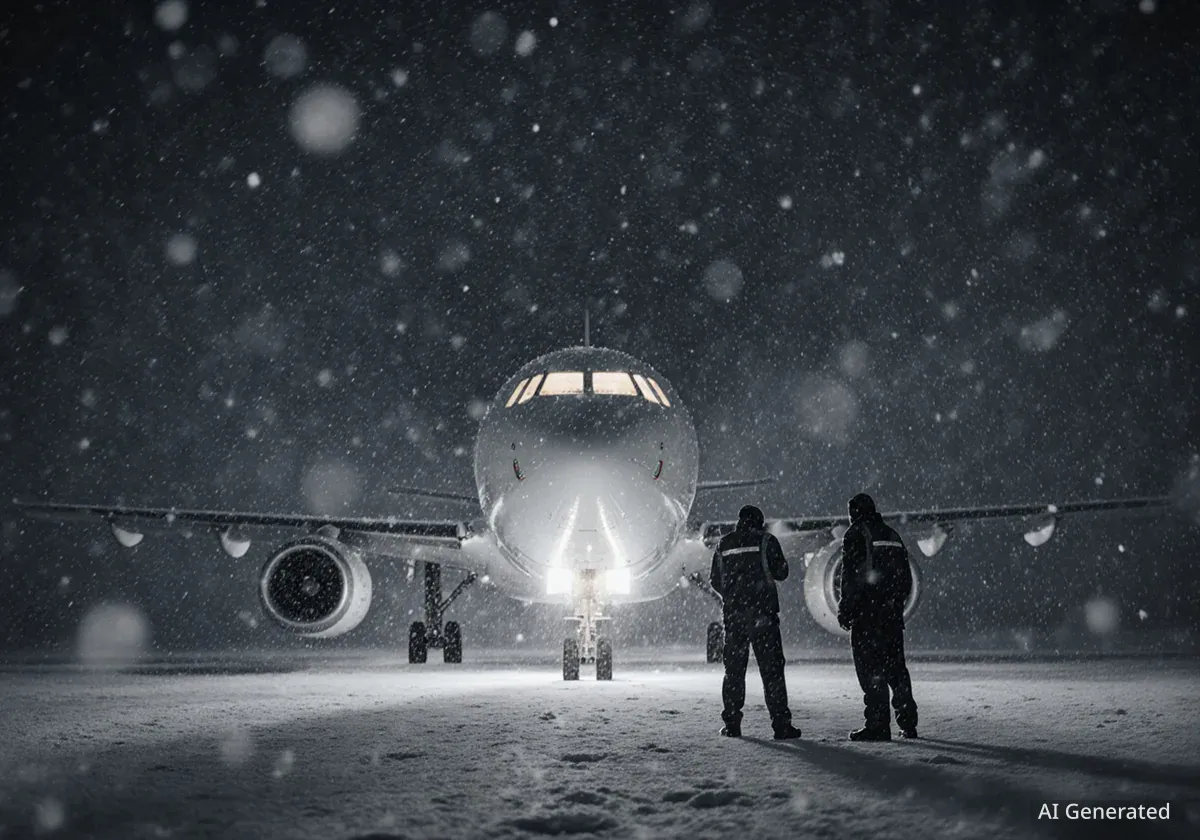
A flight carrying US Immigration and Customs Enforcement (ICE) detainees remained on the tarmac for approximately 13 hours at Portsmouth International Airport in New Hampshire. The delay occurred early Monday morning amidst a severe blizzard warning, stranding the aircraft and its passengers.
The Omni Air International flight, which originated in Harlingen, Texas, landed at 1:09 a.m. on Monday. Detainees were only able to deboard the plane and enter the terminal after 2 p.m. that afternoon, as weather conditions persisted.
Key Takeaways
- ICE detainee flight was stranded for 13 hours on a New Hampshire tarmac.
- The delay occurred during a blizzard warning at Portsmouth International Airport.
- Detainees were unable to deboard the plane until after 2 p.m. on Monday.
Blizzard Conditions Impact Arrival
The flight departed Harlingen, Texas, at 8:15 p.m. local time on Sunday. Its arrival in Portsmouth, New Hampshire, coincided with a severe winter storm hitting the region. Weather forecasts had issued a blizzard warning for the area, indicating heavy snowfall and strong winds.
The aircraft, operated by Omni Air International, touched down at Portsmouth International Airport in the early hours of Monday. Despite the landing, the detainees aboard the plane were not immediately allowed to exit the aircraft.
Fact Check
- Departure Point: Harlingen, Texas (Sunday, 8:15 p.m. local time)
- Arrival Point: Portsmouth International Airport, New Hampshire (Monday, 1:09 a.m.)
- Duration on Tarmac: Approximately 13 hours
Protocols During Inclement Weather
Airport operations during severe weather events often involve complex protocols to ensure safety. Ground crews face challenges with snow removal and de-icing. These conditions can significantly impact the ability to safely move passengers and cargo.
The decision to keep detainees on board for an extended period likely involved considerations for safety and logistical challenges posed by the blizzard. Such situations require coordination between airline staff, airport authorities, and federal agencies.
"Managing an aircraft on the tarmac during a blizzard presents significant operational hurdles, from ensuring passenger comfort to maintaining safe conditions for ground staff," stated an aviation expert familiar with airport operations, who wished to remain anonymous due to ongoing sensitivities.
Hours of Waiting on the Tarmac
For 13 hours, the ICE detainees remained inside the aircraft. The plane was parked on the tarmac, exposed to the harsh winter weather. This extended period raises questions about passenger welfare during such unforeseen delays.
It was not until after 2 p.m. on Monday that the detainees were finally permitted to deboard the plane. They were then escorted into the airport terminal. The delay highlights the difficulties that can arise when air travel intersects with extreme weather events.
Background Information
Portsmouth International Airport serves as a regional airport in New Hampshire. It handles both commercial and cargo flights. The airport is also a common destination for flights carrying ICE detainees, particularly those originating from southern U.S. states.
Winter weather in New England can be unpredictable and severe, often leading to widespread travel disruptions. Blizzards bring heavy snowfall, low visibility, and freezing temperatures, complicating all forms of transportation.
Impact on Detainees and Operations
The prolonged wait on the tarmac could have significant implications for the detainees' comfort and well-being. Access to amenities, food, and medical attention might be limited during such an extended period on an aircraft.
This incident underscores the need for robust contingency plans, especially for flights involving vulnerable populations. Airport and agency procedures must account for extreme weather and its potential impact on passenger safety and dignity.
Future Preparedness
- Review of existing protocols for extreme weather conditions.
- Evaluation of communication channels between agencies and airport staff.
- Assessment of on-board provisions for extended delays.
Officials are expected to review the circumstances surrounding this incident. The goal will be to refine procedures for similar situations in the future. Ensuring the safety and humane treatment of all passengers, including detainees, remains a priority during travel disruptions.