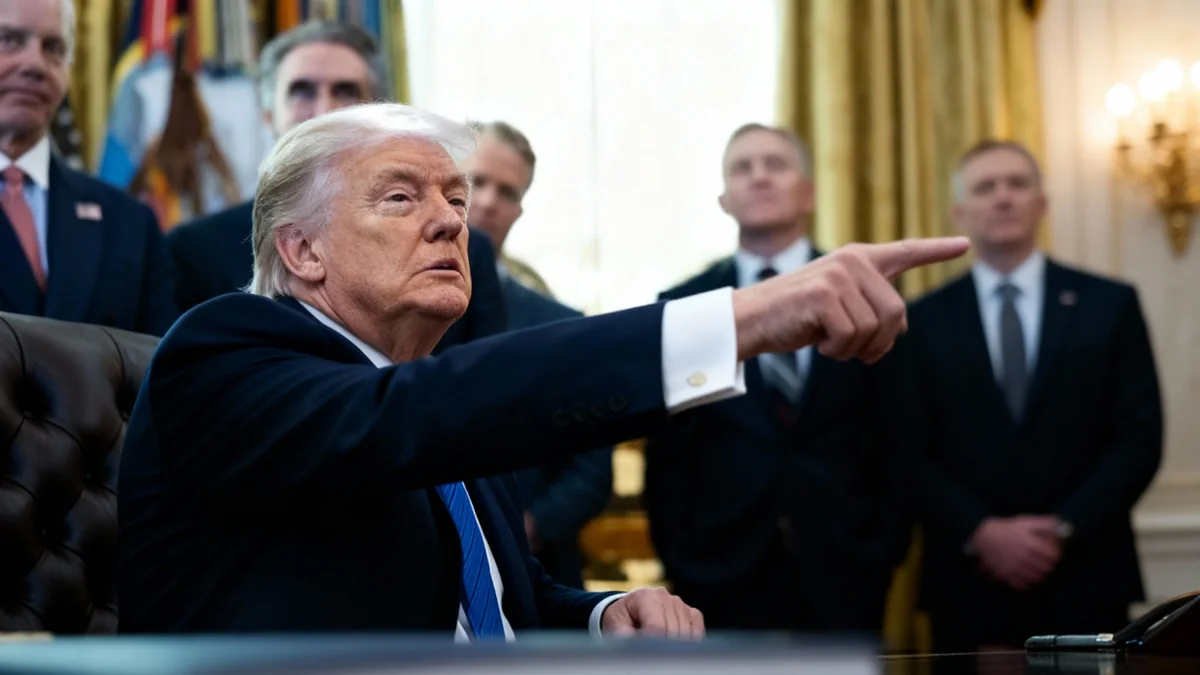
Former President Donald Trump is reportedly planning to construct a massive 250-foot tall arch in Washington D.C., named the Independence Arch. This structure would significantly exceed the height of the Lincoln Memorial and Paris's Arc de Triomphe, potentially reshaping a historically somber area of the nation's capital.
Key Takeaways
- Donald Trump proposes a 250-foot tall Independence Arch for Washington D.C.
- The planned arch would be located near Memorial Bridge, between the Lincoln Memorial and Arlington National Cemetery.
- Its height would be more than double that of the Lincoln Memorial and significantly taller than the Arc de Triomphe.
- Architectural experts express concerns about the arch's scale and its thematic impact on the proposed site.
- Funding for the project may come from leftover donations for the White House ballroom expansion.
A Monumental Vision for Washington D.C.
The proposed Independence Arch would stand at 250 feet. This height would make it more than twice as tall as the 100-foot Lincoln Memorial. It would also surpass Paris's 164-foot Arc de Triomphe. However, it would be less than half the height of the 630-foot Gateway Arch in St. Louis, Missouri.
Sources familiar with the plans indicate that Mr. Trump has identified a specific plot of land for the arch. This location is near the Memorial Bridge, which spans the Potomac River. The bridge connects the Lincoln Memorial to Arlington National Cemetery.
Height Comparison
- Independence Arch (Proposed): 250 feet
- Lincoln Memorial: 100 feet
- Arc de Triomphe (Paris): 164 feet
- Gateway Arch (St. Louis): 630 feet
Concerns Over Scale and Location
The scale of the proposed Independence Arch has raised concerns among some architectural experts. Catesby Leigh, an art critic who initially supported a smaller arch, voiced his reservations. "I don't think an arch that large belongs there," Leigh told a major news outlet.
Leigh had previously suggested a temporary, 60-foot arch to commemorate the 250th anniversary of the U.S. Declaration of Independence. Mr. Trump, however, opted for a permanent design four times larger. The funding for this ambitious project is reportedly intended to come from leftover donations meant for the $400 million White House ballroom expansion.
"If you're going to build an arch that big, you should build it in another part of town – and one possible site that comes to mind is Barney Circle," Catesby Leigh stated.
Potential Site Issues
The chosen site near Memorial Bridge is under the jurisdiction of the U.S. National Park Service. This small plot of land is positioned directly between the Lincoln Memorial and Arlington National Cemetery. Critics argue that such a large structure could obstruct pedestrian views and disrupt the existing visual relationship between these two significant memorials.
John Haigh, chairperson of Benedictine College's architecture program, described the area as a "very somber corridor." The Memorial Bridge itself was conceived as a symbol of peace between the Union and Confederacy after the Civil War. Placing a celebratory arch in this somber context, within sight of a national cemetery, could be thematically jarring.
Historical Significance of the Area
The area surrounding Memorial Bridge and the Lincoln Memorial holds deep historical and symbolic meaning. It connects sites of national mourning and remembrance, including Arlington National Cemetery, a final resting place for many American veterans. The bridge itself symbolizes unity and reconciliation.
Evolution of the Arch Concept
Mr. Trump has reportedly considered various designs and heights for the arch. At a dinner in 2025, he shared plans for more modest versions, including 165-foot and 123-foot high options. However, he ultimately decided on the 250-foot height, partly to coincide with the 250th anniversary of the U.S. Declaration of Independence.
Attendees at a White House Christmas reception quoted Mr. Trump as saying, "The one that people know mostly is the Arc de Triomphe in Paris, France. And we're gonna top it by, I think, a lot." This statement highlights his desire for the American arch to be a globally recognized landmark.
Public Discussions and Early Proposals
The idea of a grand arch in Washington D.C. has been discussed for some time. In December, Mr. Trump told Politico that he aimed to begin construction within two months. Earlier in January, he posted images of three potential designs on his Truth Social platform, one of which featured gold gilding.
Washington D.C. is unique among major global capitals for lacking a prominent triumphal arch. Rodney Mims Cook Jr., president of the National Monuments Foundation and an Atlanta philanthropist, has been appointed by Mr. Trump to the Commission of Fine Arts. This commission would theoretically oversee the arch's development.
Nicolas Leo Charbonneau, an architect recommended by Catesby Leigh, has reportedly been retained by the White House for the project. Charbonneau previously expressed enthusiasm for the idea on social media, stating, "America needs a triumphal arch!" alongside a rendering of a design.
Looking Ahead
The proposed Independence Arch represents a significant addition to Washington D.C.'s monumental landscape. Its design, scale, and chosen location will likely continue to generate considerable public and expert discussion as plans progress. The project aims to create a lasting symbol for the nation, tying its height directly to a key historical anniversary.