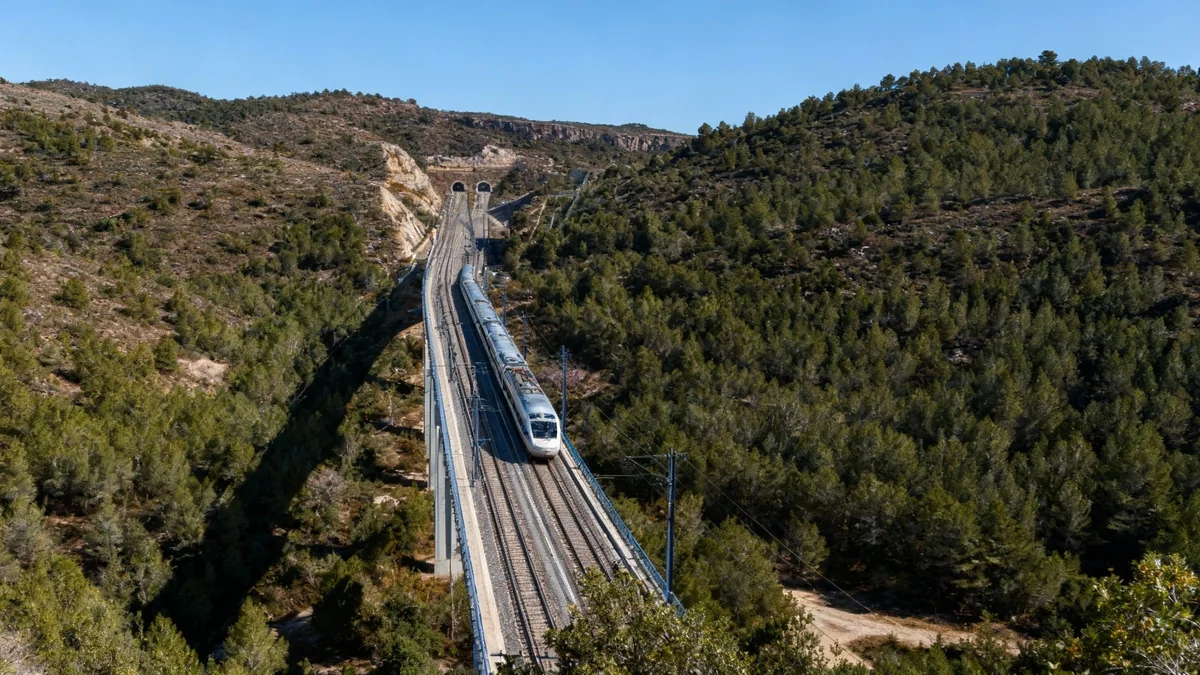
The European Commission has revealed an ambitious plan to establish a comprehensive high-speed rail network across the continent by 2040. This initiative aims to drastically cut travel times between major European cities, making train journeys a more competitive and appealing alternative to air travel.
Key Takeaways
- High-speed rail network planned across Europe by 2040.
- Journey times between cities like Lisbon-Madrid could drop from nine to three hours.
- Estimated cost for tripling the network size is €546 billion.
- Focus on improving cross-border connections and ticketing systems.
Transforming European Travel with Speed
The European Commission announced its vision for a faster, integrated high-speed rail network. This network would allow trains to reach speeds exceeding 250 km/h (155 mph) where feasible. The goal is to connect major cities more efficiently, significantly reducing travel durations and promoting more sustainable transportation.
One notable example is the proposed Lisbon to Madrid route, which could see travel time reduced from nine hours to just three hours. Similarly, the journey between Berlin and Copenhagen, currently seven hours, is projected to take only four hours by 2030. These reductions highlight the potential impact on daily commutes and leisure travel across Europe.
Fast Facts on Rail
- Lisbon to Madrid: Current 9 hours, projected 3 hours.
- Berlin to Copenhagen: Current 7 hours, projected 4 hours by 2030.
- Sofia to Athens: Current 14 hours, projected 6 hours by 2035.
- Tallinn to Riga: Current 6 hours 10 minutes, projected 1 hour 45 minutes.
Addressing Current Challenges in Cross-Border Rail
Despite existing calls to boost rail travel, fast cross-border train journeys remain uncommon across Europe. Several factors contribute to this issue, including national priorities taking precedence over international cooperation, inadequate infrastructure, and incompatible systems between different countries. Complex ticketing processes and clashing regulations also pose significant hurdles for passengers.
According to the European Commission, the current 12,128 km high-speed rail network in Europe is largely concentrated in a few western EU member states. France, Germany, Italy, and Spain host the majority of these lines, leaving central and eastern Europe with poor connections. This imbalance is a key area the new plan aims to address.
"The plans set out how to create a faster, truly European high-speed rail network by 2040," stated EU transport commissioner Apostolos Tzitzikostas. "This would make rail travel a more appealing alternative to short-haul and possibly longer flights on many routes."
Investment and Infrastructure Needs
External experts cited by the commission estimate a substantial investment of €546 billion (approximately £481 billion) is required to triple the size of the existing high-speed network. This funding would allow trains to consistently operate at speeds above 250 km/h. The EU executive has pledged to develop a financing strategy and will seek to utilize EU funds to encourage national governments and private investment, particularly for infrastructure and rolling stock.
Beyond physical tracks and trains, the plan also includes improving pan-European signaling and ticketing systems. The goal is to streamline the entire travel experience, from booking to arrival. This involves legislative proposals to ensure passengers can easily purchase cross-border tickets and extending passenger rights to support international rail travel.
Background on Rail Travel
For years, advocates have pushed for greater investment in European rail to reduce carbon emissions and offer a sustainable travel option. However, the fragmented nature of national rail systems has often hindered seamless international journeys, forcing travelers to navigate multiple booking platforms and inconsistent regulations.
Simplifying Ticketing and Passenger Rights
A key aspect of the new initiative is to simplify the booking process for cross-border journeys. Apostolos Tzitzikostas indicated that passengers should eventually be able to book a cross-border rail ticket, and even a combined rail-air ticket, through a single website. Legislative proposals are expected in early 2026 to make this a reality.
The plan also addresses passenger rights. Currently, travelers often need to contact separate national rail operators for assistance or refunds if their cross-border train is delayed. The proposed extension of passenger rights aims to provide more consistent support for those using international rail services.
- Improved pan-European signaling systems.
- Simplified cross-border ticketing platforms.
- Extension of passenger rights for international rail.
- Incentives for national governments and private investment.
Industry and Expert Reactions
The European Consumer Organisation (BEUC) has welcomed the plans as a positive step towards sustainable travel. Robin Loos, BEUC’s head of transport, noted that consumers have long faced issues like complex booking, limited passenger rights, poor connections, and inconsistent service quality when traveling by train across Europe. He believes the plan offers much-needed investment and technical harmonization, aiming to resolve long-standing ticketing problems.
The Community of Railway and Infrastructure Companies (CER), an industry body, also expressed support. CER highlighted that setting a benchmark speed of 250 km/h or higher for new lines will enable rail to effectively compete with short-haul air travel and encourage a significant shift towards trains.
However, not all experts are convinced by the current level of detail. Jon Worth, an independent rail expert, expressed skepticism regarding the feasibility of the proposed faster journeys. He pointed out a lack of specific information on funding and relatively few existing projects. Worth questioned whether the document would lead to new tracks or trains that would not have materialized otherwise, describing it as more of an "aspirational hopeful" vision rather than a concrete plan. He also referenced the EU's mixed record with lower-speed trans-European network projects, which have been slow to implement.