St. Lucie County is taking emergency action to protect a rapidly eroding section of South Beach near Jetty Park in Fort Pierce. Recent inspections showed significant vulnerability in the dune system, prompting officials to implement immediate stabilization measures. These efforts include installing concrete barriers and delivering thousands of cubic yards of sand to safeguard homes and critical public infrastructure.
Key Takeaways
- St. Lucie County deployed concrete barriers and emergency sand deliveries at Jetty Park.
- The immediate goal is to protect private homes and public infrastructure along State Road A1A.
- Approximately 10,000 cubic yards of sand will be trucked in as a short-term fix.
- A larger federal beach renourishment project, bringing 400,000 cubic yards of sand, is expected in March.
- Delays in the federal project led to the current emergency measures, costing taxpayers about $500,000.
Emergency Measures Underway
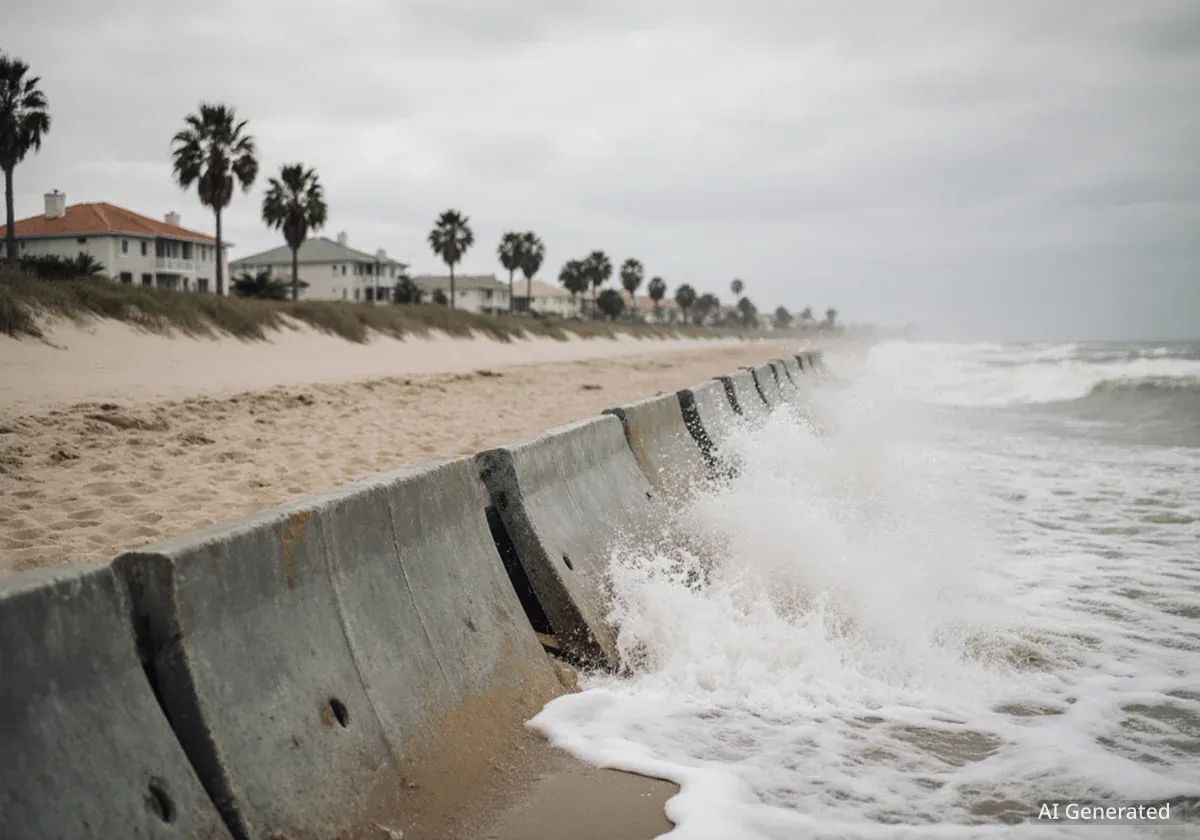
County crews moved quickly over the weekend to install concrete barriers near two private properties on Hutchinson Island. This decision came after officials determined that parts of the dune system were at risk of washing out. These barriers are designed to prevent surf and storm surge from impacting homes and public infrastructure, including sidewalks, utilities, and State Road A1A.
James Clasby, St. Lucie County Commissioner and Erosion District Chairman, supported the action.
“I was a little skeptical of it at first, because it does put concrete structure on the beach, but I do believe that it's a legitimate long-term solution to avoid doing the same thing over and over,” Clasby stated.
Quick Facts
- Emergency Sand Volume: 10,000 cubic yards (approximately 14,000 tons)
- Emergency Project Cost: About $500,000
- Federal Project Volume: 400,000 cubic yards (approximately 540,000 tons)
- Federal Project Start: Early March
- Previous Renourishment (April): 95,000 cubic yards, washed away in 6-7 months
Protecting Infrastructure and Property
The concrete structures were strategically placed next to county-owned vacant lots. These lots serve as crucial staging areas for future beach renourishment projects. Protecting this section of coastline is vital for ongoing and future recovery efforts.
Drone footage from the area shows ocean waves pushing close to the remaining dune line. Residents report that this dune once provided a substantial buffer between their homes and the ocean. The shoreline has continued to recede, increasing homeowner concerns that the next high tide or rough surf could directly impact their properties.
Sand Deliveries Begin
Emergency sand deliveries are scheduled to begin Tuesday afternoon, with mobilization already in progress. Crews plan to truck in approximately 10,000 cubic yards of sand. This short-term stabilization effort aims to reinforce weakened dune sections before a larger federal project starts.
This emergency sand operation carries an estimated cost of about $500,000 for taxpayers. Officials emphasize that this stopgap work is necessary to protect private property and public infrastructure. It addresses recent delays in a much larger federal beach renourishment project.
Background on Delays
The federal project, expected to bring roughly 400,000 cubic yards of sand, was delayed due to mechanical failures. Dredging equipment at another federally funded beach project in southern St. Lucie County experienced issues. That project must conclude before crews can move north toward Fort Pierce. Federal environmental guidelines, including sea turtle nesting requirements, also dictate the order of beach projects along the county's coastline, further impacting the schedule.
Differences in Sand Quality
The sand being delivered this week is considered beach-compatible. However, officials clarify it is not the same type of sand used in federal dredging projects. It is therefore not expected to last as long.
In April, about 95,000 cubic yards of sand were placed along the beach. County officials noted that this sand washed away within six to seven months.
“Now the federal project is much more substantial, and it's a different type of sand than what we get with these emergency truck calls,” Clasby explained. “So, we really are looking forward to the federal project starting.”
Collaborative Efforts and Future Plans
County leaders approved the emergency measures after inspections confirmed sections of the dune were highly vulnerable. If left unaddressed, these sections could allow ocean water to reach A1A and other crucial infrastructure.
Commissioner Clasby emphasized the necessity of these actions.
“Well, on everybody's tax bill, bear in mind, I'm one of the more frugal people on the county commission. I do not like spending money when it's unnecessary. I've witnessed for myself. There were parts of the dune that were clearly vulnerable to washing out, and if the ocean starts washing out onto State Road, nobody's going to like that. So, we needed to take these emergency measures in order to safeguard infrastructure at this point in time, and that's why we're doing it,” he said.
Donated Sand Contributions
- U.S. Army Corps of Engineers: 10 dump truck loads of sand donated
- Local Sand Supplier: 10 additional truckloads donated
- These donations helped reduce costs for the emergency stabilization effort.
To help reduce costs, U.S. Rep. Brian Mast facilitated the donation of 10 dump truck loads of sand from the U.S. Army Corps of Engineers. A local sand supplier also contributed 10 additional truckloads. This collaborative effort demonstrates widespread concern for the beach's condition.
The emergency sand operation is expected to continue for two to three weeks, with a delivery limit of about 5,000 cubic yards of sand per week.
Long-Term Solutions Explored
While current work focuses on immediate stabilization, county leaders are also pursuing a longer-term solution. A proposed groin project aims to slow the movement of sand along the shoreline. This project is currently awaiting approval from Congress and the U.S. Army Corps of Engineers. It would not eliminate the need for future beach renourishment but is expected to reduce the frequency of large-scale sand projects.
A temporary beach closure remains a possibility, depending on how conditions evolve in the coming days. For residents along South Beach, the rapid pace of erosion and the ocean's proximity to their homes remain a primary concern as crews work to stabilize the shoreline.
Ted Wasko, a beachgoer at Jetty Park, expressed frustration:
“They need to get this fixed as soon as they can. I don't know what they're waiting for. It's been like this for a while. This is the worst I've ever seen the way it is today.”