The Metropolitan Transportation Authority (MTA) has launched new plexiglass fare gates at two New York City subway stations. These modern gates are designed to replace traditional turnstiles, aiming to improve passenger experience and reduce fare evasion across the system.
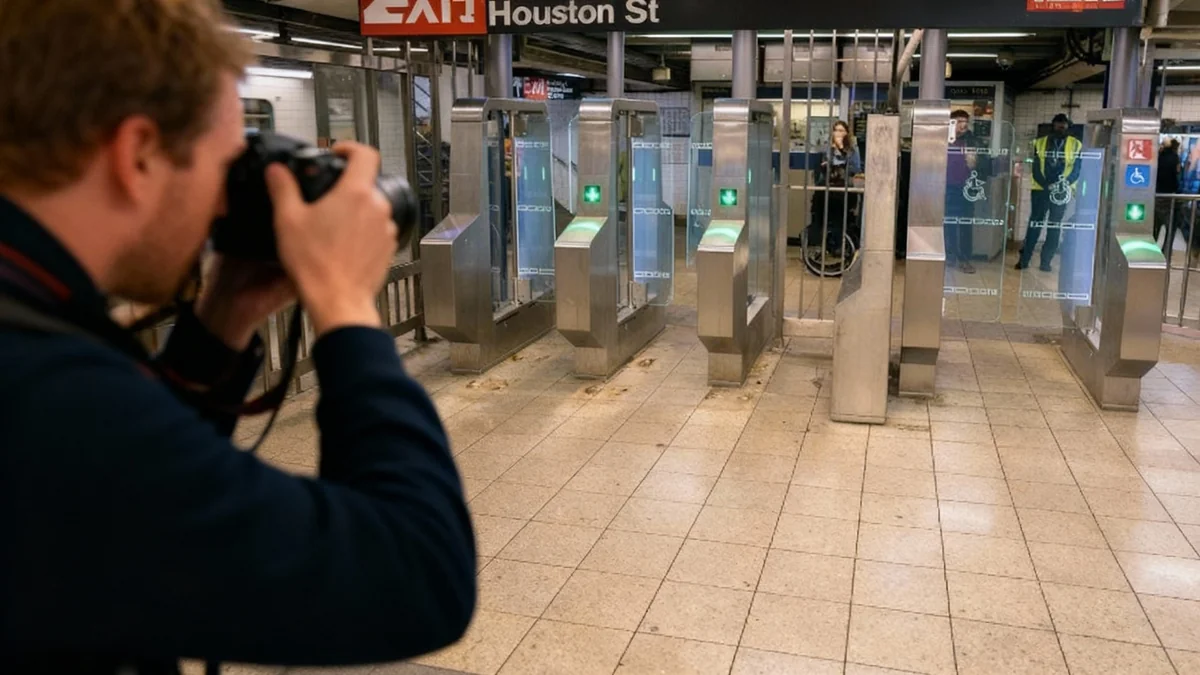
The new installations are part of a larger initiative to modernize subway entrances. They feature motorized plexiglass panels that open upon payment, offering a different approach to station access.
Key Takeaways
- New fare gates are now active at Broadway-Lafayette and Third Ave.-138th St. stations.
- The design aims to reduce fare evasion and improve accessibility.
- Three companies are competing for the citywide contract.
- A pilot program will roll out gates at 20 stations in total.
Modernizing Subway Access
The MTA's long-term plan to update subway entry systems took a significant step forward on Friday. New fare arrays began operation at the Broadway-Lafayette station, serving the B, D, F, M, and No. 6 lines in SoHo. Simultaneously, the Third Ave.-138th St. station for the No. 6 line in Mott Haven, South Bronx, also received the new gates.
Jamie Torres-Springer, the MTA's head of construction and development, highlighted the dual benefits of the new gates. "They're going to improve the passenger experience, and ensure that we minimize fare evasion," Torres-Springer stated. He also indicated that more gates would be installed across the boroughs in the coming days and weeks.
Fact Check
- The MTA has allocated $1.2 billion in its five-year capital budget for fare gate installations.
- The goal is to equip 150 subway stations with the new technology.
Addressing Fare Evasion and Accessibility
The new fare gate design moves away from the rotating turnstiles that have been a fixture of subway entrances for decades. Instead, motorized plexiglass panels slide open when a fare is paid. This design makes it harder for individuals to jump over or duck under the barriers, a common method of fare evasion.
Beyond security, the gates significantly enhance accessibility. Quemuel Arroyo, the MTA's chief accessibility officer, emphasized this point. "This is a look into the future, folks," Arroyo said, explaining that the pilot program aims to "enhance what access looks like at the MTA."
"The point of this pilot is really to enhance what access looks like at the MTA, and give people that grace to enter with ease, smoothly, like everybody else." — Quemuel Arroyo, MTA Chief Accessibility Officer
Improved Entry for All Riders
The gates are designed to accommodate passengers using wheelchairs, carrying luggage, or pushing strollers. This addresses a long-standing challenge with traditional turnstiles, which can be difficult to navigate for these groups.
Sensors integrated into the gates play a crucial role. They trigger an alarm if someone attempts to enter without paying. These sensors also help the gates detect when a passenger is entering with large luggage, adjusting the opening for easier passage. Furthermore, children under 40 inches tall, who ride for free, can pass through the system without needing to duck under a barrier.
Background on Fare Gate Development
The MTA has been exploring alternatives to traditional turnstiles for several years. The current installations are part of a competitive process involving multiple firms. The agency is evaluating the performance of these different systems before making a final decision on a citywide contract.
Companies Vying for Citywide Contract
The fare arrays currently being tested at Broadway-Lafayette and Third Ave.-138th St. were built by Conduent, a U.S. firm. Conduent is one of three companies competing for the contract to replace turnstiles across the entire city.
Another contender is STraffic, which supplies fare gates for the Washington, D.C., Metro system. Cubic, a third firm, previously piloted its technology at the Sutphin Blvd.-Archer Ave. station in Queens during 2023. The MTA expects to make a decision on the winning firm sometime next year.
Pilot Program Expansion
- The initial pilot will involve 20 stations throughout the subway system.
- Upcoming installations include 42nd St.-Port Authority (A, C, E lines), Bedford Park Blvd. (B, D lines), and Atlantic Ave.-Barclays.
Future of Subway Entry
The introduction of these new fare gates marks a significant modernization effort for the MTA. The focus remains on creating a more efficient, secure, and accessible subway experience for all passengers. The results of this pilot program will inform the broader rollout across the system.
With an investment of $1.2 billion earmarked in the MTA's five-year capital budget, the agency plans to install these new gates in 150 subway stations. This represents a substantial overhaul of the entry points for millions of daily commuters.
The ongoing testing and evaluation will ensure that the chosen system meets the diverse needs of New York City's subway ridership. This initiative is a clear indicator of the MTA's commitment to improving public transit infrastructure.