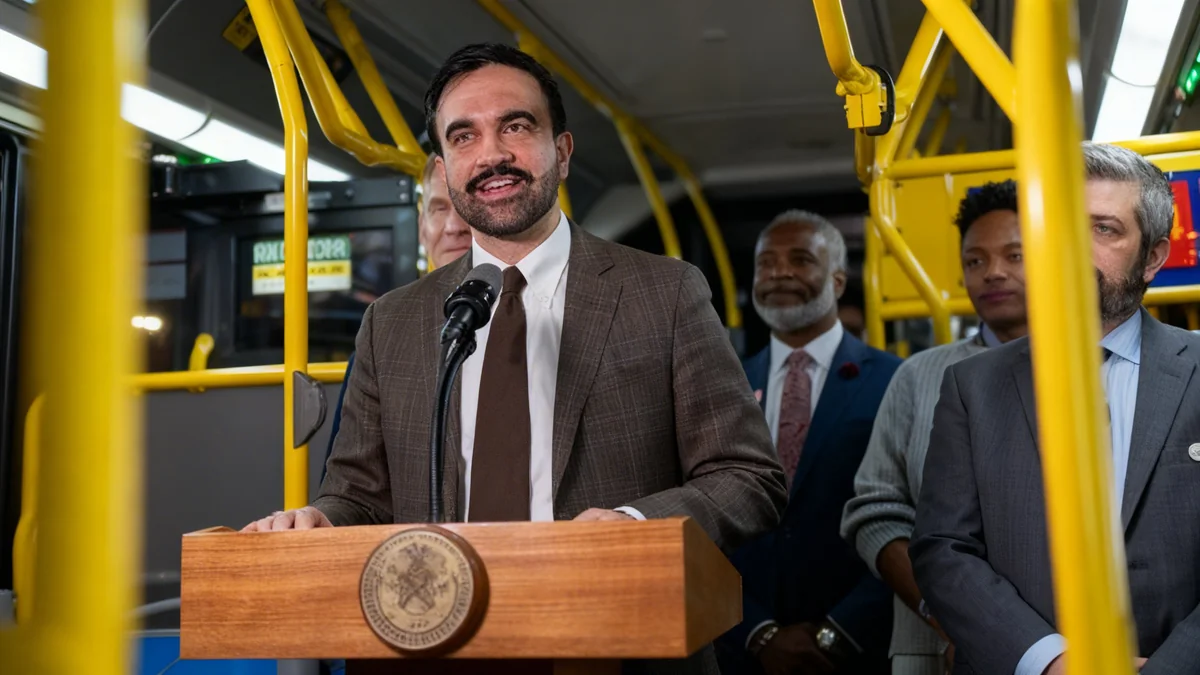
New York City Mayor Zohran Mamdani announced a series of new transportation projects on Friday, reversing several decisions made by the previous administration. The new initiatives are designed to improve commute times for the city's bus riders and cyclists, starting with a key project in the Bronx.
During a press conference held on a city bus, the mayor confirmed plans to install dedicated bus lanes on Fordham Road, the busiest bus corridor in the Bronx. This move directly overturns a previous decision by former mayor Eric Adams to scale back a more comprehensive street redesign on the same route.
Key Takeaways
- Mayor Zohran Mamdani is reversing several transit policies of the former Adams administration.
- The plan includes new offset bus lanes for Fordham Road, the Bronx's busiest bus route.
- The initiative aims to speed up commutes for bus riders and improve safety for cyclists.
- This marks a significant shift in the city's approach to street design and public transportation.
A New Transit Policy for New York
Mayor Mamdani's announcement signals a clear change in direction for New York City's transportation policy. The focus is now squarely on prioritizing public transit and active transportation methods like cycling.
The decision was revealed during a unique press event aboard a bus in the Bronx, a borough heavily reliant on public transportation. The setting was chosen to emphasize the direct impact these changes will have on daily commuters.
"Too many New Yorkers have seen their precious time treated with casual disdain, as if it does not matter," Mayor Mamdani stated during the announcement.
This new policy framework will re-evaluate and, in some cases, restore projects that were previously canceled or significantly altered. The goal is to address traffic congestion and make bus travel a more reliable and efficient option for millions of residents.
The Fordham Road Overhaul
The centerpiece of the mayor's announcement is the plan for Fordham Road. This major thoroughfare serves as a critical artery for commuters in the Bronx, which is the city's most bus-dependent borough.
The new plan calls for the installation of offset bus lanes. This design places the bus lane one lane away from the curb, which helps prevent double-parked cars and delivery vehicles from blocking the path of buses. This configuration is intended to maintain a consistent flow for public transit.
Previous Plans for Fordham Road
Under the administration of former mayor Eric Adams, an ambitious street redesign for Fordham Road was canceled. It was replaced with a less comprehensive version that critics argued did little to improve bus speeds or traffic flow. The decision was reportedly made in response to pressure from local political interests concerned about the removal of parking or changes to traffic patterns.
By reviving a more robust plan for the corridor, the Mamdani administration aims to directly tackle the slow bus speeds that have long frustrated commuters in the area. The project is seen as a test case for how the new city government will handle similar infrastructure challenges in other boroughs.
Impact on City Commuters
For the average New Yorker, these changes could mean shorter and more predictable travel times. The Fordham Road project alone is expected to benefit tens of thousands of daily bus riders.
The Bronx by the Numbers
- The Bronx is New York City's poorest borough.
- It has the highest percentage of residents who rely on bus transportation for their daily commute.
- Fordham Road is consistently ranked as one of the busiest and slowest bus routes in the entire city.
Beyond the Bronx, the policy shift suggests that other stalled projects could be revived. Advocates for better public transit and cycling infrastructure are hopeful that this announcement is the first of many. The administration's actions indicate a willingness to prioritize the movement of people over the movement of vehicles, a philosophy central to modern urban planning.
The changes are not just about speed. Dedicated bus and bike lanes are also associated with significant safety improvements for all road users by creating a more organized and predictable street environment.
A Shift from the Previous Administration
The new initiatives represent a direct departure from the policies of former Mayor Eric Adams. During his term, several projects aimed at improving bus and bike travel were either halted or scaled back. These decisions often came after initial support from the city's own Department of Transportation.
The Adams administration was often seen as prioritizing the concerns of drivers and local businesses who opposed the removal of parking spaces or changes to traffic flow. This approach led to frustration among transit advocates and daily commuters who felt their needs were being ignored.
Mayor Mamdani's new direction suggests a different set of priorities. By explicitly reversing his predecessor's decisions, he is sending a message that bus riders and cyclists are a key focus for his administration. The emphasis is now on data-driven solutions to improve the efficiency and equity of the city's transportation network.
This policy change aligns New York City with other major global cities that are actively redesigning streets to favor public and alternative transportation methods over private car use. The long-term vision is a more sustainable, equitable, and less congested city for all residents.