
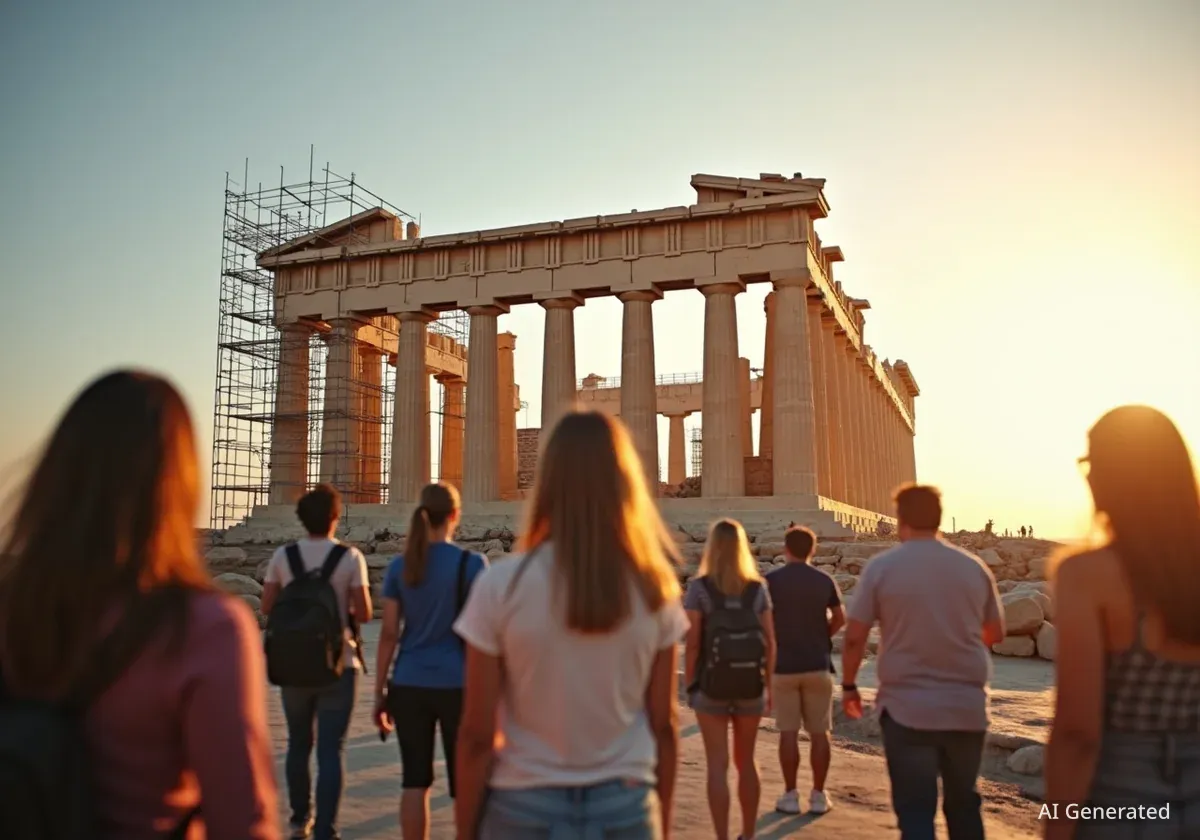
Athens, Greece – For the first time in approximately two centuries, the exterior of the Parthenon temple on the Acropolis hill is completely free of scaffolding. This significant milestone was reached after the removal of long-standing restoration structures, offering visitors an unobstructed view of the ancient monument, particularly from its western façade.
Key Takeaways
- Scaffolding on the Parthenon's western façade has been removed after about 20 years.
- This marks the first time in roughly 200 years that the entire exterior is free of scaffolding.
- New, lighter scaffolding will be erected on the western side within a month for continued conservation.
- The renewed conservation work is expected to last until early summer 2026.
- The Acropolis received 4.5 million visitors in 2024, making it Greece's most popular tourist site.
Unveiling the Parthenon's Western Face
Visitors walking along the broad pedestrian street at the base of Athens’ Acropolis Hill can now experience a unique view. The scaffolding that covered the western façade of the Parthenon for around two decades has been taken down. This specific side offers the clearest street-level perspective of the 5th century B.C. temple.
The removal process for the western section concluded in late September. This change provides a much clearer, uncluttered view of the UNESCO World Heritage site. Many tourists are seeing the monument in a way that has not been possible for a very long time.
Fast Fact: UNESCO World Heritage Site
The Acropolis of Athens, including the Parthenon, was inscribed as a UNESCO World Heritage site in 1987. It is recognized for its universal value as the supreme architectural and artistic expression of ancient Greek civilization.
A Monument Free of Obstruction
Culture Minister Lina Mendoni highlighted the historical importance of this event. According to Mendoni, this is the first time in approximately 200 years that the Parthenon's exterior is entirely free of any scaffolding. This includes all sides of the ancient structure.
"For visitors, it is like they are seeing a different, a completely different monument," Mendoni stated in an interview on Skai radio on Friday.
This period of an unobstructed view will be temporary. Conservation efforts are ongoing and essential for the monument's preservation. The current clear view offers a rare opportunity for both locals and international tourists.
Ongoing Restoration Efforts
While the current clear view is notable, it is part of a larger, continuous restoration project. The respite from scaffolding will not last indefinitely. New structures are planned for future work.
Approximately one month from now, new scaffolding will be installed on the Parthenon’s western side. However, Mendoni noted that this new equipment will be "lighter and aesthetically much closer to the logic of the monument." This indicates a focus on minimizing visual impact while still allowing necessary work to proceed.
Historical Context of Parthenon Restoration
The Parthenon has undergone various phases of damage and restoration throughout its history. Significant conservation work intensified in the late 20th century to address structural issues and damage from pollution and past interventions. These efforts aim to preserve the integrity of the ancient temple for future generations.
Future Outlook for the Parthenon
The renewed conservation work, starting with the installation of the new scaffolding, is projected to continue until early summer of 2026. After this phase, the minister expressed optimism for a more extended period of clear views.
"The Parthenon will be completely freed of this scaffolding too, and people will be able to see it truly free," Mendoni confirmed. This long-term vision aims to ensure the monument's stability while allowing maximum public appreciation.
Visitor Statistics for the Acropolis
- 2024 Visitors: 4.5 million
- The Acropolis remains Greece’s most popular tourist destination.
- This high visitor count underscores the importance of ongoing preservation and accessibility.
Significance of the Ancient Temple
The Parthenon is a marble temple constructed in the mid-5th century B.C. It was dedicated to Athena, the patron goddess of Athens. Its architectural and historical significance is immense, representing the height of classical Greek art and architecture.
The temple stands as a symbol of democracy, philosophy, and art, influencing Western civilization for centuries. Its enduring presence on the Acropolis continues to draw millions of visitors annually, making its preservation a global priority.
Impact on Tourism
The Acropolis is by far Greece’s most visited tourist site. In 2024, it attracted 4.5 million people, according to the country’s statistical authority. The ability to view the Parthenon without scaffolding is a significant draw for these visitors.
An unobstructed view enhances the visitor experience, allowing for clearer photographs and a deeper appreciation of the monument's scale and detail. This temporary clarity could further boost interest in visiting Athens and its ancient wonders.
Preserving a Global Treasure
The continuous restoration work on the Parthenon reflects a global commitment to preserving cultural heritage. The meticulous efforts involve archaeologists, architects, and engineers working to ensure the monument's longevity.
These projects often require significant time and resources, balancing the need for conservation with the desire for public access. The alternating periods of scaffolding and clear views are a necessary part of this ongoing process.